


What if new payment and AML rules make onboarding so heavy sellers leave before their first sale?
Here’s what changed: regulators and processors now demand deeper identity proofing, beneficial‑owner data, threshold‑based seller reporting, and continuous sanctions screening.
Why it matters: those checks raise costs, slow approvals, and can cut conversion 20–50% when applied at sign‑up.
Thesis: marketplaces that switch to staged, risk‑based KYC, smart automation, and targeted monitoring will meet compliance without tanking growth.
How Updated Payment and AML Rules Reshape Marketplace Onboarding and KYC

Payment and AML rules have shifted how marketplaces verify sellers and buyers. Regulations like PSD2 Strong Customer Authentication (SCA), PCI DSS v4.0, the EU 6th Anti‑Money Laundering Directive, the Anti‑Money Laundering Act of 2020, the Corporate Transparency Act’s Beneficial Ownership Information (BOI) reporting requirement, DAC7 seller reporting, and the INFORM Consumers Act now require stricter data collection, tighter verification timing, and ongoing sanctions screening. Marketplaces collect beneficial owner details for corporate sellers, verify sellers who cross specific revenue or transaction thresholds, and continuously screen against updated sanctions lists. All while trying to keep onboarding conversion rates from tanking.
The INFORM Consumers Act sets precise thresholds that trigger mandatory verification: sellers with at least $5,000 gross revenue or at least 200 transactions in a 12‑month period must be verified and have contact, bank, and tax information collected. Sellers exceeding $20,000 in a 12‑month period must have their name, contact, and address disclosed to buyers. The Corporate Transparency Act requires beneficial ownership information collection for new entities starting January 1, 2024, with staggered deadlines for existing entities extending into 2024–2025. Enhanced due diligence now applies automatically for politically exposed persons (PEPs), transactions over $10,000, and activity from high‑risk jurisdictions. Payment processors like Stripe, PayPal, and Square enforce these requirements because their own banking partners and money‑transmitter licenses demand documented compliance from every merchant on the platform.
The operational consequences? Immediate and measurable. Adding full KYC (document upload, selfie/liveness check, identity verification) increases abandonment by roughly 20–40% compared to lightweight sign‑up flows. On mobile‑first platforms, heavy upfront friction can cut conversions by up to 50%. Manual review processes commonly take 2–7 business days and cost roughly $10–$60 per case, while automated identity verification (IDV) and KYB tools reduce median approval time to 5–20 minutes. Automation and rules‑based triage can reduce manual review volume by 50–80%, but only if the marketplace adopts risk‑based, staged verification flows rather than front‑loading every check at registration.
Six most significant compliance shifts marketplaces must adopt:
- Beneficial ownership collection and verification — Collect name, date of birth, ownership percentage, ID number, and residential address for individuals with ≥25% or ≥50% ownership, depending on jurisdiction, and maintain records for 5–7 years.
- Threshold‑based seller verification — Implement automated triggers at $5,000/200 transactions (INFORM initial verification) and $20,000 (public disclosure requirement), plus internal risk thresholds at $1,000 and $10,000.
- Continuous or periodic sanctions and PEP screening — Move from point‑in‑time KYC to perpetual screening with watchlist refresh latency under 24 hours and daily or weekly rebatching.
- Enhanced due diligence for high‑risk signals — Apply stricter checks for high chargeback rates, high volume of international sales, transactions above $100, subscription/recurring payments, prepaid gift cards, cryptocurrency, and gambling verticals.
- Strong customer authentication and transactional controls — Integrate Address Verification System (AVS), Card Verification Value (CVV) checks, 3D Secure (3DS) issuer‑based authentication, and two‑factor authentication (2FA) for account access.
- Audit trail and evidence retention — Maintain timestamped logs, decision rationale, analyst notes, and versioned evidence storage for at least 5 years to satisfy regulator and auditor review.
Regulation Categories That Now Drive Marketplace Onboarding and KYC Design

Regulations affecting marketplace onboarding fall into five distinct impact categories, each imposing different verification, data, and workflow requirements. Payment authentication rules (primarily PSD2/SCA and PCI DSS v4.0) mandate multi‑factor authentication for EU card payments and raise expectations for tokenization, encryption, and secure credential handling. Anti‑money laundering frameworks (the EU 6th Anti‑Money Laundering Directive, the Anti‑Money Laundering Act of 2020, and FATF recommendations on virtual assets) expand the definition of obliged entities, require beneficial ownership identification, and impose continuous monitoring and enhanced due diligence for high‑risk accounts. Cross‑border reporting obligations, such as DAC7 and the INFORM Consumers Act, force marketplaces to collect, verify, and in some cases publicly disclose seller identity and business information when revenue or transaction thresholds are crossed.
Corporate transparency and beneficial ownership rules (most notably the U.S. Corporate Transparency Act) require beneficial ownership information (BOI) reporting for newly formed entities beginning January 1, 2024, and apply staggered deadlines for existing entities throughout 2024–2025. Marketplaces collect BOI for counterparties, suppliers, and high‑volume sellers to satisfy both their own payment processor requirements and direct regulatory obligations. Finally, payment facilitator and platform obligations mean that marketplaces are increasingly treated as the first line of defense in fraud and AML enforcement. Payment processors impose KYC, KYB, and transaction‑monitoring requirements on marketplaces because processors themselves must satisfy banking partners and maintain money‑transmitter licenses across jurisdictions.
Primary regulatory impact categories shaping onboarding and KYC:
- Payment authentication and security standards — PSD2/SCA, PCI DSS v4.0, transactional controls (AVS, CVV, 3DS).
- AML and sanctions compliance — 6AMLD, AMLA 2020, FATF Travel Rule, sanctions/PEP/adverse media screening.
- Seller reporting and transparency — DAC7, INFORM Consumers Act thresholds and disclosure requirements.
- Corporate transparency and beneficial ownership — Corporate Transparency Act BOI reporting, UBO identification at ≥50% ownership.
- Payment facilitator risk and liability transfer — Processor‑imposed KYC/KYB, transaction caps, high‑risk merchant classification, and account suspension triggers.
How Payment Rule Changes Increase Verification Depth for Sellers

Payment‑specific regulations (particularly Strong Customer Authentication under PSD2 and the updated security requirements in PCI DSS v4.0) introduce identity requirements that extend beyond the checkout flow and into seller onboarding. SCA mandates that payment authentication must incorporate at least two independent factors (something you know, something you have, something you are), which has driven wider adoption of two‑factor authentication (2FA) for account access and biometric verification during identity proofing. PCI DSS v4.0 strengthens expectations for tokenization, encryption, and authentication workflows, pushing payment processors to require marketplaces to document that sellers (especially those handling card‑not‑present transactions) meet baseline security and identity standards before processing live payments.
Payment‑linked verification changes marketplaces must implement:
- Address Verification System (AVS) checks — Require billing address match for card‑not‑present transactions to reduce chargeback risk and satisfy processor fraud controls.
- Card Verification Value (CVV) checks — Enforce CVV collection and validation to confirm card possession at transaction time.
- 3D Secure (3DS) authentication — Implement issuer‑based authentication to shift liability for fraudulent transactions and meet SCA requirements in the EU.
- Two‑factor authentication (2FA) for account access — Require multi‑factor login for seller accounts to prevent account takeover and unauthorized payout changes.
- Enhanced checks for high‑risk transaction patterns — Apply stricter verification for high chargeback rates, high volume of international sales, transactions above $100, and subscription/recurring payment models.
- Bank account verification for payouts — Use micro‑deposit confirmation or instant bank verification APIs to confirm account ownership before first payout.
- Processor‑mandated KYB for payment facilitators — Collect business registration documents, tax IDs, beneficial owner information, and proof of address to satisfy banking partner and money‑transmitter licensing requirements.
These verification steps add operational workload and potential friction at onboarding. Marketplaces that front‑load all payment‑linked checks at registration see conversion drops of 20–40% on average. Payment processors escalate verification requirements based on observed fraud signals (chargebacks, international volume, high‑ticket sales, subscription billing), which means marketplaces must build dynamic, risk‑based verification flows rather than static onboarding forms. The trade‑off is clear: lighter initial checks preserve conversion but increase downstream fraud exposure, while heavier upfront verification reduces fraud but increases abandonment and time‑to‑first‑sale.
AML Rule Updates and Their Direct Impact on Marketplace KYC/KYB

AML directives have expanded the scope of who must be verified, what data must be collected, and how often screening must occur. The EU 6th Anti‑Money Laundering Directive, which entered into force on December 3, 2020, broadens criminal liability and due‑diligence expectations, treating marketplaces and payment facilitators as obliged entities in many scenarios. The Anti‑Money Laundering Act of 2020 and the Corporate Transparency Act’s Beneficial Ownership Information (BOI) reporting requirement impose mandatory beneficial owner data collection for corporate sellers and service providers, including name, date of birth, ownership percentage, ID number, and residential address for individuals with 50% or greater ownership. Enhanced due diligence (EDD) is required for complex ownership structures, politically exposed persons (PEPs), activity from high‑risk jurisdictions, and any transactions exceeding $10,000.
Sanctions and PEP screening has moved from a point‑in‑time check at onboarding to continuous or periodic re‑screening. Rapid sanctions expansion (most notably the coordinated sanctions responses following the Russia–Ukraine conflict) has materially increased the number and complexity of sanctions listings, requiring marketplaces to refresh watchlist datasets in near‑real time (commonly under 24‑hour latency) and implement daily or weekly rebatching of existing accounts. Legacy name‑matching systems yield high false‑positive volumes, especially for common names, which drives up manual review costs. Machine learning and AI‑based entity matching can reduce false positives by 30–50% compared to rule‑only systems, but implementation requires investment in vendor integration and ongoing model tuning.
Marketplaces also “unwrap” corporate structures to identify subsidiaries and ultimate beneficial owners. Compliance now treats entities with 50% or greater ownership as in‑scope even if subsidiaries aren’t explicitly listed on sanctions lists, which means marketplaces need tools that traverse corporate ownership across jurisdictions. Failure to identify sanctioned entities, majority‑owned subsidiaries, or beneficial owners can trigger enforcement actions under AML frameworks and cause reputational harm, account suspension by payment processors, and higher processing fees.
| Requirement | Trigger | Marketplace Impact |
|---|---|---|
| Beneficial owner (UBO/BOI) collection | Corporate seller, ≥50% ownership, new entity formation after Jan 1 2024 | Must collect name, DOB, ownership %, ID number, address; retain for 5–7 years; may require multi‑step KYB flow |
| Enhanced due diligence (EDD) | PEP status, high‑risk jurisdiction, transaction >$10,000, complex ownership | Additional documentation, source‑of‑funds verification, senior analyst review; delays onboarding by 2–7 days if manual |
| Continuous sanctions/PEP screening | All active sellers, updated watchlists, geopolitical events | Daily or weekly rebatch; watchlist refresh <24 hours; false positives increase manual review volume by 20–50% without ML |
| Ownership unwrapping and subsidiary identification | Seller is corporation with subsidiaries, ≥50% ownership rule | Requires corporate structure graphing tools; increases onboarding complexity and data collection scope |
| Trigger‑based re‑verification | Payout setup, bank detail change, suspicious transaction flag, periodic review (annual/biannual) | Reactivates KYC/KYB flow; can block payouts until resolved; requires audit trail and versioned evidence storage |
Measuring the Onboarding Friction and Conversion Impact of Stricter KYC
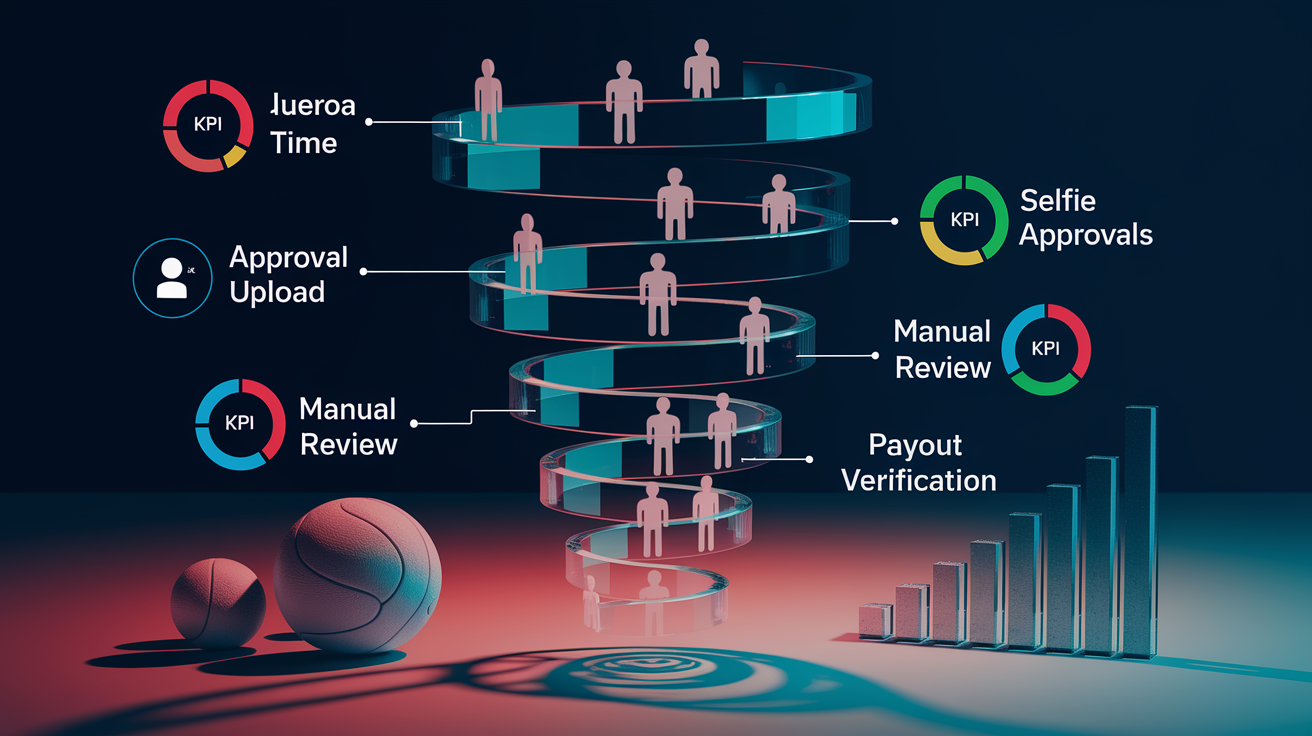
Stricter KYC requirements introduce measurable friction at multiple points in the onboarding funnel. Adding full KYC (document upload, selfie/liveness check, and identity verification) increases abandonment by roughly 20–40% compared to lightweight email‑and‑password sign‑up flows. On mobile‑first platforms, immediate heavy friction can cut conversions by up to 50%, especially when users are required to upload documents mid‑session without the option to return later. Manual KYC and KYB reviews take 2–7 business days on average and cost roughly $10–$60 per case depending on complexity. Automated identity verification (IDV) tooling reduces median approval time to 5–20 minutes and can achieve first‑pass automated acceptance rates above 70%.
Marketplaces that rely on legacy, rule‑based sanctions screening experience high false‑positive rates, which increase the volume of accounts requiring manual review. Without machine learning, false positives can represent 20–50% of flagged accounts, which directly increases operational cost and time‑to‑onboard. Automation and AI‑driven entity matching can reduce false positives by 30–50%, but implementation requires integration investment and ongoing vendor governance. Progressive KYC (collecting minimal data at sign‑up and escalating checks only before payout or when risk thresholds are crossed) has been shown to reduce initial abandonment by 15–30% while still satisfying regulatory requirements.
Six measurable KPIs to track for updated KYC/KYB onboarding:
- Onboarding completion rate — Percentage of users who begin registration and complete all required verification steps; target >60% for low‑risk flows.
- Time‑to‑approve — Median time from registration to verified/approved status; aim for <20 minutes for automated flows, <48 hours for manual reviews.
- Automated‑approve percentage — Share of accounts approved without manual intervention; target >70% to control operational cost.
- Manual review volume — Absolute count and percentage of accounts requiring manual review; track trend to measure automation effectiveness.
- False‑positive rate — Percentage of flagged accounts that are cleared after manual review; use as input for ML model tuning; aim to reduce by 30–50% post‑ML deployment.
- Payout‑block rate — Percentage of sellers blocked from first payout due to incomplete or failed KYC; high rates indicate friction points that need progressive KYC or better communication.
Technical Architecture Adjustments Required for Compliant Onboarding

Meeting updated payment and AML requirements demands significant changes to onboarding system architecture. Marketplaces integrate identity verification (IDV) APIs that combine optical character recognition (OCR) for document data extraction, liveness detection to prevent spoofing, and database checks against government records. OCR accuracy must meet or exceed 95% for primary ID fields to keep false rejects low and reduce user re‑submission rates. Liveness and biometric verification should combine passive and active checks to achieve false‑reject rates below 3% while maintaining automated acceptance rates above 70% on first pass.
Sanctions, PEP, and adverse media screening requires near‑real‑time integration with watchlist data providers and the ability to refresh datasets with latency under 24 hours. Marketplaces implement event‑driven workflows (commonly using webhooks) to trigger re‑screening when sanctions lists are updated, when a seller changes bank details, or when transaction patterns trigger risk thresholds. Transaction monitoring must layer rule‑based detection (flagging amounts above $10,000, rapid micro‑transaction patterns, or high international volume) with machine learning anomaly detection to reduce false positives by 30–50% and identify novel fraud patterns that rules alone would miss.
Dynamic, risk‑based verification flows allow marketplaces to apply different KYC depth based on transaction amount, geography, product type, and historical behavior. Low‑risk sellers might complete onboarding with only email verification and bank‑account linking via instant bank verification APIs (which confirm account ownership in under 30 seconds), while high‑risk sellers (those in prepaid gift cards, cryptocurrency, or gambling verticals, or those crossing $5,000/$10,000 thresholds) trigger full KYB, beneficial owner extraction, and manual review before the first payout. Audit trails must capture timestamps for each verification step, decision rationale, analyst notes, and versioned evidence storage to satisfy regulator and auditor review for 5–7 years.
Five architectural components essential for compliant onboarding:
- Modular IDV/KYC/KYB API integrations — Connect to third‑party vendors for document OCR (≥95% accuracy), liveness detection, database verification, and beneficial ownership extraction; prefer vendors with API latency under 5 seconds for real‑time UX.
- Sanctions/PEP/adverse media screening engine — Implement continuous or event‑triggered screening with watchlist refresh <24 hours, ML entity matching to reduce false positives, and audit logs for every match and decision.
- Dynamic, risk‑based verification orchestration — Build rule engines that apply different KYC depth based on seller risk score, transaction thresholds, geography, and product vertical; use event‑driven workflows (webhooks) to escalate checks in real time.
- Transaction monitoring and anomaly detection — Layer rule‑based alerts (>$10,000, international volume spikes, chargeback thresholds) with ML models that flag unusual patterns; aim to reduce false positives by 30–50% versus rules alone.
- Evidence storage and audit trail system — Maintain timestamped decision logs, versioned document storage, analyst review notes, and lineage for every verification step; retain for 5–7 years; ensure queryable access for regulator and auditor review.
Designing Low‑Friction User Experiences Under Stricter KYC Rules

Stricter KYC requirements create a fundamental tension between compliance and conversion, but thoughtful UX design can preserve onboarding rates while meeting regulatory obligations. Progressive KYC (collecting minimal data at sign‑up and deferring full verification until before the first payout or when a risk threshold is crossed) reduces upfront abandonment by 15–30%. This approach allows sellers to list products and build presence on the marketplace before encountering friction, which increases perceived value and commitment before the verification hurdle. Mobile‑first capture, using in‑app camera flows with guided framing and real‑time feedback, reduces bad or unusable images by roughly 40%, which lowers re‑submission rates and speeds approval.
Inline validation and real‑time feedback during data entry reduce user errors and repeat attempts by roughly 20%. Showing a live check of ID number format, flagging mismatched addresses, or confirming that a bank account number passes a checksum before submission prevents wasted round trips and user frustration. Instant bank verification APIs (using open banking where available) can confirm account ownership in under 30 seconds, replacing the traditional micro‑deposit flow that takes 2–3 business days. Autofill and data reuse, pulling verified information from previous sessions or trusted third‑party sources, shortens onboarding forms and reduces cognitive load, especially for repeat sellers or buyers who operate across multiple marketplaces.
Seven design patterns for minimizing KYC friction:
- Progressive disclosure and staged verification — Require only email and basic business info at sign‑up; defer document upload, beneficial owner collection, and bank verification until before first payout or when seller crosses $1,000/$5,000 thresholds.
- Asynchronous verification with status updates — Allow sellers to submit documents and continue building their storefront while verification runs in the background; send push notifications or email updates on approval status and next steps.
- Autofill and pre‑populated fields — Pull business name, address, and tax ID from authoritative databases (e.g., company registries) or previous verified sessions to reduce manual data entry.
- Mobile‑optimized camera capture with guided framing — Use in‑app SDKs that overlay guides for ID placement, auto‑capture when quality thresholds are met, and provide instant feedback on glare, blur, or cropping issues.
- Exemptions and fast‑track paths for low‑risk users — Apply lighter verification for users with strong reputation signals (verified history on other platforms, trusted referral sources, or low transaction amounts).
- Clear explainability and expected timelines — Show step‑by‑step progress bars, estimated approval times, and plain‑language explanations of why each document or data point is required to reduce drop‑off due to confusion.
- Fallback to human support for edge cases — Provide live chat or callback options for users who encounter errors or whose documents fail automated checks, preventing silent abandonment.
Operational Processes and Compliance Governance for Updated AML/KYC Rules

Meeting updated AML and payment rules requires disciplined operational processes and governance structures. Marketplaces maintain audit trails with timestamps, decision rationale, and analyst notes for every verification step, storing evidence for at least 5 years (many jurisdictions require 5–7 years). Suspicious activity must be escalated promptly, with internal service‑level agreements (SLAs) to review and decide on Suspicious Activity Report (SAR) filing within 24–72 hours of case confirmation for high‑risk incidents. Transaction monitoring thresholds (commonly set at $1,000, $5,000, and $10,000) should trigger automated alerts and escalation workflows, with clear documentation of why each threshold was chosen and how alerts are triaged.
Marketplaces implement trigger‑based re‑verification or rechecks when sellers update bank details, request payouts, or exhibit transaction patterns flagged by monitoring rules. Contractual AML/KYC obligations with payment processors should be documented, including agreed verification standards, transaction caps, remediation timelines, and escalation paths for disputed flags or account suspensions. Continuous sanctions monitoring requires operational cadence: daily or weekly rebatch of existing accounts against updated watchlists, with procedures for immediately freezing transactions and escalating hits to senior compliance staff.
Compliance teams must be staffed to handle manual review volume, false‑positive remediation, and regulator inquiries. As automation reduces first‑pass manual reviews by 50–80%, team roles should shift toward exception handling, model tuning, vendor governance, and audit preparation. Regulatory change management (tracking new rules, assessing impact, and updating systems and policies) must be a continuous process, not a one‑time project.
Five operational controls marketplaces must implement:
- Audit trail and evidence retention — Capture timestamps, decision rationale, analyst notes, and versioned document storage for every KYC/KYB step; retain for 5–7 years; ensure queryable access for regulator and auditor review.
- SAR/CTR review and filing SLAs — Establish internal timelines (24–72 hours) for reviewing flagged accounts, deciding on SAR filing, and documenting the rationale; maintain templates and escalation paths.
- Transaction threshold policies and monitoring cadence — Define thresholds ($1k/$5k/$10k) that trigger alerts, manual review, or EDD; document the business and risk rationale; review thresholds quarterly as fraud and regulatory environments evolve.
- Contractual alignment with payment processors — Document agreed KYC/KYB standards, transaction caps, remediation timelines, and escalation paths in processor contracts; monitor processor policy updates and adjust internal flows accordingly.
- Continuous sanctions screening and freeze procedures — Implement daily or weekly rebatching of active accounts, maintain watchlist refresh latency <24 hours, and define freeze, escalation, and remediation workflows for positive matches.
Choosing and Evaluating Third‑Party KYC/KYB Vendors Under New Rules

Selecting the right KYC/KYB vendor is critical to balancing compliance, cost, and conversion. Marketplaces should prioritize vendors whose OCR and document verification accuracy meets or exceeds 95% for primary ID fields, which keeps false rejects low and reduces user re‑submission. Liveness and biometric verification capabilities should combine passive and active checks to achieve false‑reject rates below 3% while maintaining automated acceptance rates above 70% on first pass. Machine learning for sanctions and entity matching is essential to reduce false positives by 30–50% compared to legacy rule‑only systems, which directly lowers manual review volume and operational cost.
Vendor evaluation must include sanctions and PEP screening cadence and data freshness. Look for providers that refresh watchlists with latency under 24 hours and support event‑driven or real‑time re‑screening when lists are updated. Beneficial ownership and corporate structure extraction tools are increasingly important under the Corporate Transparency Act and 6AMLD. Vendors should be able to traverse multi‑jurisdictional ownership hierarchies and extract ultimate beneficial owners (UBOs) down to individuals. API latency and reliability matter for user experience. Aim for identity verification API responses under 5 seconds to keep onboarding flows smooth, and confirm vendor SLAs for uptime and support response times.
Six criteria marketplaces must review before selecting a KYC/KYB provider:
- OCR and document verification accuracy — Require ≥95% accuracy on primary ID fields (name, DOB, ID number, expiration) to minimize false rejects and user re‑submits; test with representative documents from target markets.
- Machine learning for entity matching and false‑positive reduction — Confirm vendor uses ML to improve sanctions/PEP screening; ask for measured false‑positive reduction (target 30–50% improvement versus rule‑only baselines).
- Sanctions/PEP/adverse media data coverage and refresh speed — Verify coverage of OFAC, EU, UK, UN sanctions lists plus PEP databases; require watchlist refresh latency <24 hours and support for event‑driven re‑screening.
- Beneficial ownership (UBO/BOI) extraction and corporate graphing — Ensure vendor can traverse multi‑jurisdictional ownership structures, extract individuals with ≥25% or ≥50% ownership, and provide audit‑ready documentation.
- API latency, uptime SLA, and integration support — Target API response times <5 seconds for real‑time onboarding flows; require uptime SLA ≥99.5% and responsive technical support for integration issues.
- Evidence storage, audit trails, and retention compliance — Confirm vendor provides timestamped decision logs, versioned document storage, and analyst review notes; ensure retention options for 5–7 years and compatibility with regulator/auditor access requirements.
Case Examples: How Marketplaces Adapt to Updated Payment and AML Requirements

Real‑world marketplace implementations show measurable improvements when onboarding systems are re‑architected for updated payment and AML rules. One mid‑sized marketplace introduced tiered KYC and automated identity verification, replacing a purely manual process that averaged 48 hours approval time. By integrating an IDV API with OCR, liveness detection, and risk‑based escalation rules, the marketplace reduced average onboarding time to 12 minutes for low‑risk sellers and increased seller activation by 22%. Manual review volume dropped 78%, freeing compliance staff to focus on high‑risk cases and complex beneficial ownership verification. The marketplace also implemented dynamic thresholds at $1,000 and $5,000, deferring full KYB until sellers crossed these levels, which preserved conversion on low‑value sign‑ups.
Another platform focused on progressive KYC and instant bank verification to reduce friction at the critical payout step. By allowing sellers to list products and build storefronts before completing full verification, the platform deferred KYC friction until sellers had demonstrated commitment and value. Integrating an instant bank verification API shortened bank‑linking from 2–3 business days (micro‑deposit method) to under 30 seconds, which improved payout conversion by 35% and reduced payout‑related disputes by 40%. The platform also added real‑time sanctions screening and continuous monitoring, which caught high‑risk accounts earlier and reduced chargeback exposure.
| Marketplace Size | Key Change Implemented | Measured Result |
|---|---|---|
| Mid‑sized (5,000–20,000 sellers) | Tiered KYC + automated IDV (OCR, liveness, risk‑based escalation) | Onboarding time: 48 hours → 12 minutes; seller activation +22%; manual review volume ‑78% |
| Growing platform (10,000–50,000 sellers) | Progressive KYC + instant bank verification API | Payout conversion +35%; payout disputes ‑40%; bank‑linking time: 2–3 days → <30 seconds |
| Large marketplace (>100,000 sellers) | ML‑based sanctions screening + continuous monitoring + UBO extraction | False positives ‑45%; manual review cost ‑60%; high‑risk account detection +30% earlier in lifecycle |
Key Considerations to Keep in Mind When Adapting Onboarding to Updated AML and Payment Rules
Marketplace operators must recognize that regulatory compliance is a continuous process, not a one‑time project. Sanctions lists and regulatory expectations evolve rapidly, especially in response to geopolitical events, which means marketplaces refresh watchlist data in near‑real time (under 24‑hour latency) and implement event‑driven re‑screening workflows. Risk‑based verification tiers (applying different KYC depth based on transaction amount, geography, product type, and seller behavior) allow marketplaces to preserve conversion for low‑risk users while satisfying enhanced due diligence requirements for high‑risk accounts. Alignment with payment processor obligations is non‑negotiable. Marketplaces that fail to meet processor KYC/KYB standards face immediate consequences including higher fees, transaction caps, or account suspension.
Audit readiness requires disciplined evidence retention and decision logging. Marketplaces maintain timestamped records, analyst notes, and versioned document storage for at least 5 years (commonly 5–7 years across jurisdictions) and ensure these records are queryable and accessible for regulator and auditor review. Marketplaces should prepare for ongoing regulatory updates by building modular, API‑based onboarding architectures that can accommodate new verification requirements, data fields, and screening sources without requiring full system rewrites.
Five actionable reminders for marketplace operators:
- Refresh sanctions and PEP data continuously — Maintain watchlist refresh latency under 24 hours; implement event‑driven re‑screening when lists update or sellers trigger risk thresholds.
- Maintain risk‑based verification tiers — Apply light‑touch KYC for low‑risk users and escalate to full KYB, beneficial owner extraction, and EDD for high‑risk signals (high transaction amounts, international volume, high‑risk verticals).
- Align contractually with payment processor requirements — Document agreed KYC/KYB standards, transaction caps, and remediation timelines in processor contracts; monitor processor policy updates and adjust internal flows accordingly.
- Keep audit trails and evidence for 5–7 years — Maintain timestamped decision logs, versioned document storage, and analyst review notes; ensure queryable access for regulator and auditor review.
- Build modular, API‑based onboarding architectures — Use third‑party IDV/KYC/KYB APIs, sanctions screening engines, and transaction monitoring tools to accommodate future regulatory changes without full system rewrites.
Final Words
In the action: updated payment and AML rules are forcing marketplaces to tighten seller verification, collect BOI/UBO data, and run continuous sanctions and PEP screening. SCA, PCI v4.0, and new BOI requirements are the main drivers.
That raises documentation needs, manual-review costs, and onboarding friction unless you lean on automated IDV, staged KYC, and clear UX guidance.
Start with quick wins—progressive KYC, IDV APIs, and the right KPIs. The impact of updated payment and AML rules on marketplace onboarding and KYC is real, but manageable, and you can protect conversion while staying compliant.
FAQ
Q: How are payments and AML KYC related?
A: Payments and AML KYC are linked because payment rules and processors require identity checks, BOI collection, and transaction monitoring to stop fraud and money‑laundering; map payment triggers to KYC tiers and automate checks.
Q: What is the AML KYC onboarding process?
A: The AML KYC onboarding process is a risk‑based flow: intake and risk scoring, ID and BOI verification, sanctions/PEP screening, EDD for high risk, approval or manual review, then ongoing monitoring.
Q: What is the new rule of the KYC update and what happens if KYC isn’t updated?
A: The new KYC update requires BOI/UBO collection for new entities, stricter thresholds (INFORM reporting levels), and continuous sanctions/PEP screening; if KYC isn’t updated, payouts may be blocked, accounts suspended, and fines follow, so notify sellers and automate rechecks.