

Think FedEx international shipping is just “print a label and send it”?
Not even close, with rates and surcharges that swing by lane, service, and package size, so a 2-pound parcel from San Francisco to London can cost $29 if you’re patient or more than $90 for overnight.
This guide explains FedEx’s service tiers, how rates and surcharges hit your margin, and the delivery checks to run before you print a label so you stop getting surprise fees.
Understanding FedEx International Shipping Requirements and Options
FedEx international shipping gives you a handful of time-based services to move packages across borders. Each one’s built for different needs. Before you print a label, you’ve got to pick a service, punch in weight and dimensions, enter the destination, and match customs info to what’s actually in the box. The system spits back a rate, transit estimate, and surcharge breakdown based on those inputs.
Rates move around depending on the lane (where it’s going from where), how fast you need it, package size, and which surcharges kick in. A 2-pound parcel from San Francisco to London might cost $29 if you’re patient or push past $90 if you need it there tomorrow. FedEx bills on actual weight or dimensional weight, whichever’s bigger. That means your packaging choices hit the bottom line directly.
Things you need to sort out before quoting or shipping:
- Service tier – pick based on order value and what you promised the customer, not what you always do.
- Weight and dimensions that match reality – one inch can shift you into a cheaper tier.
- Clearance rules at the destination – customs intensity and paperwork vary country to country.
- Product data that’s complete – missing or wrong HS codes, vague descriptions, or off declared values create delays.
- Declared value and insurance – expensive shipments often justify faster service just to lower risk exposure.
- Customer communication – slower services need clear delivery windows set upfront.
Why FedEx International Shipping Challenges Occur

Most international problems start with bad or incomplete info entered before the package leaves. Customs flags shipments when declared values don’t line up with invoices, HS codes are generic or missing, or product descriptions sound like placeholders. Carriers misroute packages when addresses are incomplete, formatted wrong, or translated poorly.
Manual work makes this worse at scale. One person picking services for 400 daily orders will make inconsistent calls when they’re racing the clock and juggling cost targets, customer promises, and carrier options. Small mistakes compound fast. A transposed digit in customs value, a missing apartment number, wrong service click—any of these turns into delivery failure, surprise duties, or a return to sender.
Operational causes behind international shipping problems:
- HS codes that are vague or incomplete – inspectors hold shipments for manual review.
- Declared values that don’t match invoices – mismatches trigger audits and delays.
- Packaging that’s too big for the weight – dimensional pricing bills on space, not grams.
- Missing recipient tax IDs – Brazil, India, parts of the EU won’t clear without them.
- Service selection that’s all habit – using express for low-margin orders kills profit; using economy for expensive shipments creates support headaches.
- Goods that are restricted or undeclared – lithium batteries, cosmetics, food, electronics face rules that shift by lane.
Dimensional weight formulas punish air inside boxes. FedEx calculates cubic size as (length × width × height) ÷ 139, then bills whichever’s higher—actual weight or that dimensional number. A light but bulky package gets charged at the inflated weight, sometimes doubling or tripling the cost versus a box that actually fits. Carriers stack surcharges on top of base rates too: fuel adjustments that change weekly, handling fees for oversized or weird shapes, remote area charges for sparse zip codes, residential fees when it’s going to a house instead of a loading dock.
Choosing the Right FedEx International Shipping Service

FedEx splits its international options into three service tiers. Each one trades speed, cost, and risk differently. The choice should follow what the shipment’s worth, what you told the customer, and how much delivery risk you can stomach. Not reflex or convenience.
FedEx International Priority
International Priority is the fastest option, usually hitting major markets in 1 to 3 business days. Use it when speed protects revenue or prevents bigger costs down the line. High-value orders where a delay triggers a chargeback. Replacement shipments where you’re already late. Orders going to customers with tight project deadlines. Speed works like insurance here: FedEx takes most of the delivery risk because the service locks in tight transit windows and prioritizes these shipments through hubs and customs lines.
Priority costs more because FedEx accepts more operational responsibility. These packages move on dedicated aircraft, get processed through customs ahead of slower tiers, and get faster intervention when something goes wrong. For products with margins above 40 percent or order values over a few hundred bucks, the premium often makes sense. A $70 shipping charge that prevents a $400 refund and keeps a customer is cheaper than the alternative.
FedEx International Economy
International Economy trades speed for lower cost. Transit stretches out in exchange for margin protection on orders where urgency’s low and customer expectations got set clearly upfront. This works when delivery windows are communicated at checkout, when products are restocks rather than time-sensitive buys, and when the customer relationship can absorb a few extra transit days without generating tickets or bad reviews.
Economy shifts more delivery risk to you. The package moves through the same network but at lower priority. Sorted after Priority shipments, potentially held for consolidation, cleared through customs on a slower track. Cost savings can be real—30 to 50 percent below Priority on the same lane—but those savings vanish if you didn’t prep customers for longer windows or if the order value doesn’t justify the trade. A low-margin consumable restocked monthly fits this service. A first-time buyer’s trial order probably doesn’t.
FedEx International Connect Plus
International Connect Plus was built specifically for cross-border ecommerce. It balances cost, tracking quality, and delivery speed for shipments that don’t need express handling but require more visibility and reliability than old-school economy options. The service reaches 195 countries and territories in 4 to 8 business days, includes end-to-end tracking across carrier handoffs, simplifies customs workflows, and removes the residential surcharge that adds cost to home deliveries on other FedEx international tiers.
Connect Plus typically runs 15 to 25 percent cheaper than International Economy while giving you better operational transparency. It’s the service that makes sense for standard DTC orders. Products with moderate margins, repeat customers who understand cross-border timing, and order values that justify tracked delivery but not express speed. A $100 apparel order to the UK or a $150 electronics accessory to Australia both fit. The lack of residential surcharge alone saves $4 to $6 per package, and consistent tracking cuts down “where’s my order” inquiries that eat support time.
Picking the right service starts with defining what failure costs. If a delayed or lost shipment triggers a refund, replacement, and lost future orders, faster services work as operational insurance. If the customer was told “delivery in 7 to 10 business days” and the margin can’t support express pricing, Connect Plus or Economy become the rational move—provided you’ve got messaging, escalation paths, and support capacity ready to handle the occasional delay.
Understanding FedEx International Shipping Rates and Surcharges

FedEx starts with a base shipping charge tied to service tier, lane, and billable weight, then layers surcharges that adjust weekly or trigger when specific package or destination traits show up. The base rate reflects distance, speed commitment, and competitive positioning within the lane. Surcharges cover operating cost swings (fuel prices, demand spikes, handling complexity) and edge cases (remote regions, oversized items, residential addresses). Together they set the final invoice.
On January 5, 2026, FedEx rolled out a 5.9 percent general rate increase across international services. That percentage describes the shift in published list rates, but actual cost impact for most shippers runs higher—typically 8 to 12 percent—once surcharge adjustments and threshold changes get factored in. For example, FedEx lowered the additional handling weight threshold for international packages from 70 pounds to 55 pounds. Shipments that dodged the surcharge in 2025 now trigger it in 2026, adding cost even if the list rate stayed flat.
Common surcharge types on FedEx international shipments:
- Fuel surcharge – floats weekly based on jet fuel spot prices; typically adds 15 to 25 percent to base rate.
- Residential delivery surcharge – applied when shipping to a home instead of a commercial address (waived on Connect Plus).
- Additional handling surcharge – triggered when a package exceeds 55 pounds, measures longer than 48 inches, or needs irregular handling (second-longest side plus shortest side exceeds 105 inches).
- Remote area surcharge – applied to low-density or hard-to-reach postal codes; varies by destination country.
- Oversize surcharge – separate fee for packages exceeding maximum length or girth limits, stacked on top of additional handling fees.
- Declared value fee – percentage-based charge when insuring shipments above standard liability limits (typically above $100).
- Out of delivery area surcharge – applies to specific regions where FedEx uses contract carriers for final delivery.
| Cost Driver | Impact |
|---|---|
| Dimensional weight exceeds actual weight | Billed at higher DIM weight; oversized packaging can double or triple cost |
| Service tier selection | Priority costs 2–3× Economy on same lane; speed premium reflects risk allocation |
| Residential vs. commercial destination | Residential surcharge adds $4–6 per package (except Connect Plus) |
| Remote area or out of delivery area destination | Flat surcharge per package; can add $30–50 depending on country and carrier contract terms |
You get the most cost control by fixing dimensional weight and service tier alignment before the package leaves. A box measuring 16 × 12 × 10 inches that weighs 3 pounds gets billed at 14 pounds under FedEx dimensional weight rules—(16 × 12 × 10) ÷ 139 = 13.8, rounded to 14. Shrink that box to 14 × 10 × 8 inches and the DIM weight drops to 8 pounds, cutting shipping cost nearly in half. Once surcharges trigger, they’re non-negotiable line items. Packaging decisions are fully in your control and deliver immediate, repeatable margin protection.
Preparing Documents for FedEx International Shipping

Every FedEx international shipment needs electronic customs data entered before the label prints: detailed product description, Harmonized System (HS) tariff code, declared value, country of manufacture, and recipient contact info. FedEx sends this data ahead of the physical package to customs authorities in the destination country, so clearance can start while the shipment’s in transit. Missing, vague, or wrong data stops that process and holds the package at the border until you provide usable information or the shipment gets sent back.
Above each destination country’s de minimis threshold—the value below which duties and taxes get waived—a formal commercial invoice becomes mandatory. That invoice must itemize each product, assign the correct HS code, state unit price and total value, and declare shipper and recipient details in a format that matches the destination’s customs requirements. The EU eliminated its €150 duty-free threshold effective July 1, 2026, replacing it with a temporary €3 duty per tariff subheading for shipments under €150 until July 1, 2028. A parcel containing three different product categories—apparel, electronics, cosmetics—now incurs €9 in duties even if total declared value is only €80. Canada maintains two thresholds for U.S. origin courier shipments under CUSMA: below CA$40, no duties or taxes apply; between CA$40 and CA$150, duties are waived but provincial and federal taxes get assessed and collected by the carrier at delivery.
Required documents and data for FedEx international customs clearance:
- Commercial invoice – itemized product list with HS codes, unit prices, total value, and shipper/recipient details; required above de minimis thresholds.
- HS tariff codes – six to ten digit classification codes that determine duty rates; generic or incorrect codes trigger inspection delays.
- Declared value – must match invoice total and reflect actual transaction price, not retail or aspirational pricing.
- Country of manufacture – stated for each line item; affects duty calculations under trade agreements and rules of origin.
- Recipient tax ID or VAT number – mandatory in Brazil, India, and parts of the EU for B2B and high-value shipments.
- Shipper’s EIN or tax ID – required on commercial invoices for U.S. export compliance.
- Product material composition – textiles, chemicals, and electronics often require composition percentages for classification and safety compliance.
- Reason for export – sale, gift, sample, return, or repair; affects duty treatment and valuation rules.
FedEx and other carriers have shifted almost entirely to electronic customs workflows. Paper CN22 and CN23 forms once stapled to international parcels are now replaced by data entered in the carrier’s shipping platform or transmitted via API from an order management or multi-carrier system. Accuracy at the point of data entry determines clearance speed. A missing digit in an HS code, a product description reading “general merchandise,” or a declared value that’s rounded instead of exact will generate a customs query, delay the shipment, and often require you to email corrected documentation while the package sits in a bonded warehouse.
Packaging Requirements for FedEx International Shipping Success

International parcels travel farther, change hands more often, and face rougher handling than domestic shipments. A package leaving a U.S. fulfillment center may pass through a regional sort hub, international gateway, customs inspection, destination country carrier handoff, and final mile delivery across multiple vehicles and climates before reaching the recipient. Packaging must protect contents through that entire chain while minimizing dimensional weight and staying within carrier size and weight limits.
FedEx publishes maximum dimensions and weight limits by service: International Priority and Economy both accept packages up to 108 inches in length and 130 inches in combined length plus girth (length + 2 × width + 2 × height), with a maximum weight of 150 pounds per package. International Connect Plus has tighter restrictions—packages must stay under 68 pounds and fit within 108 inches in length. Shipments exceeding these limits require freight services instead of small package networks, triggering different pricing, longer transit times, and additional documentation.
Strong outer corrugate, interior cushioning rated for the product’s fragility, and secure closure (reinforced tape on all seams) are baseline requirements. International shipments should use new, structurally sound boxes rather than reused or damaged materials. A box that survived one domestic trip may fail under the stress of international handling and climate variation. Products with high value or fragility—electronics, glassware, precision instruments—benefit from double boxing: the product in a fitted inner box with cushioning, then that box placed inside a slightly larger outer box with additional fill to prevent shifting.
Packaging best practices for FedEx international shipments:
- Right size boxes to product dimensions – eliminate excess air and reduce dimensional weight penalties; even one inch can drop cost tiers.
- Use cushioning rated for product weight and fragility – bubble wrap, foam inserts, or air pillows; avoid loose fill peanuts that shift during transit.
- Seal all seams with pressure sensitive tape rated for shipping – apply tape along center seam and edges; skip masking tape, duct tape, or string.
- Protect address labels and customs documents – use clear packing tape over printed labels or self-adhesive pouches to prevent water damage and tearing.
- Mark “Fragile” or “This Side Up” only when the product genuinely requires it – overuse of cautionary labels reduces their effectiveness; handlers prioritize based on visible cues and service tier.
- Test packaging for common failure modes – drop tests from waist height onto corners, edges, and flat sides reveal weak points before the carrier finds them.
Standardized packaging—a set of five to seven box sizes covering 90 percent of SKU variations—helps control margin exposure and operational consistency. When fulfillment teams choose from a limited menu of known dimensions, dimensional weight calculations become predictable, cost estimates stabilize, and the risk of an operator grabbing an oversized box under time pressure drops. Audit packaging choices at the SKU level: if a product consistently ships in a box triggering dimensional weight billing two tiers above its actual weight, either the packaging’s wrong or the product needs re-engineering.
Tracking and Managing FedEx International Shipments

FedEx tracking begins when a shipment gets tendered and continues through final delivery or return to origin. Each scan—acceptance at pickup, arrival at sort facility, departure from gateway, customs clearance, out for delivery—updates the tracking record and generates a timestamped event visible to shipper and recipient. International Connect Plus offers end-to-end tracking across 195 destinations, meaning visibility persists even when FedEx hands the package to a local partner for final delivery, a feature that separates it from postal-based international services where tracking often goes dark after the shipment leaves the origin country.
Tracking exceptions signal deviations from the expected delivery path: a package held at customs pending document review, a delivery attempt where no one was available to sign, an incorrect address needing correction before the carrier can proceed. These exceptions require action—submitting missing customs paperwork, updating recipient contact details, authorizing release without a signature—and the speed of that response directly affects whether the package completes delivery or returns to sender. FedEx provides exception codes and descriptions in the tracking interface, but interpreting them and deciding the correct response often falls to your ops or support team.
Proof of delivery (POD) and signature services offer documentation that a shipment reached the intended recipient and was accepted. Standard international services capture electronic proof of delivery—often a scanned signature or photo of the package at the delivery location—while premium signature options require a specific individual to sign and can restrict delivery to the named recipient only. POD records become critical during chargeback disputes or high-value shipment investigations: a timestamped signature with recipient name and delivery address provides evidence the transaction completed as promised, reducing the likelihood that a payment processor sides with a “never received” claim.
Cost Saving Strategies for FedEx International Shipping

Cost control in international shipping starts with service tier discipline: using International Priority only when speed justifies the premium, defaulting to Connect Plus for standard ecommerce orders, and reserving Economy for low-value or time-permissive shipments where customer expectations got set clearly. FedEx International Connect Plus typically costs 15 to 25 percent less than International Economy while delivering better tracking and removing the residential surcharge, making it the economically rational choice for most direct-to-consumer cross-border orders. Priority should work as insurance for high-value shipments or situations where delivery delay triggers downstream costs—refunds, reshipments, lost lifetime value—that exceed the service premium.
Rate shopping at quote time captures pricing variability across carriers and services. A 5-pound package to Germany might cost $62 via FedEx International Economy, $48 via Connect Plus, $71 via UPS Worldwide Saver, and $58 via DHL Express Economy—all with comparable transit times. Multi-carrier platforms pulling live rates and presenting them side by side let operators or automated rules select the lowest cost option that meets delivery requirements, preserving margin without adding manual work. Commercial platform rates, negotiated through shipping software providers or third-party logistics partners, often run 20 to 40 percent below retail carrier rates and include fuel surcharge discounts unavailable when buying labels directly from FedEx.
Actionable cost saving tactics for FedEx international shipments:
- Switch standard DTC orders from Economy to Connect Plus – captures 15 to 25% cost savings and improves tracking quality without sacrificing delivery speed.
- Use flat rate international boxes for dense, heavy for size items – avoids dimensional weight penalties when actual weight is high relative to package size.
- Audit packaging at SKU level and eliminate oversized boxes – even one inch can drop a package to a lower DIM weight tier and cut cost by 20 to 30%.
- Rate shop at quote time across FedEx, UPS, DHL, and USPS – pricing varies by lane, and the cheapest carrier for one destination may not be cheapest for another.
- Negotiate or access commercial pricing through a multi-carrier platform – discounted rates and lower fuel surcharges can reduce cost 20 to 40% below retail.
- Automate service selection based on order value and destination – removes operator discretion and applies consistent cost control rules at scale.
- Consolidate low-value orders when possible – shipping two small items together in one package costs less than two separate shipments and reduces per unit handling.
- Monitor and challenge remote area and out of delivery area surcharges – postal code databases update; addresses that were remote last year may now qualify for standard delivery.
Multi-carrier models use FedEx alongside UPS, DHL, USPS, and regional carriers, routing each shipment to the service balancing cost, transit time, and tracking quality for that specific lane and package profile. A lightweight parcel under 4 pounds to Canada might route to USPS First-Class Package International Service at $27; a 10-pound shipment to the UK could default to FedEx Connect Plus; a high-value order to Australia might justify DHL Express. Automation enforces those decisions consistently, removing the variability and bias coming from manual selection and preventing habitual overuse of express services that erodes margin without delivering measurable value.
Preventing FedEx International Shipping Issues Before They Occur
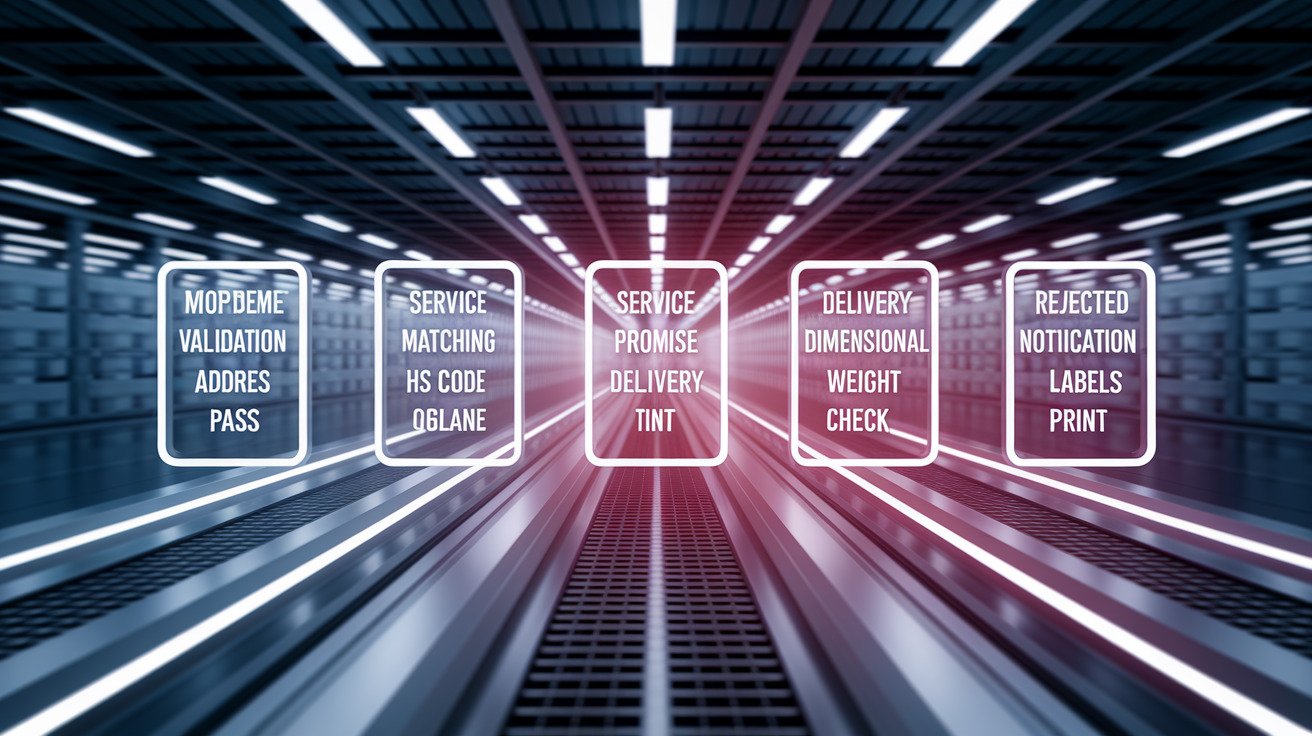
Prevention starts with automation translating shipping intent into repeatable execution. Manual service selection introduces inconsistency: one operator defaults to Priority because it feels safer, another picks Economy to hit a cost target, a third toggles between services based on workload and time pressure. Automated rules enforce business logic at scale—route orders above $200 to Priority, send standard DTC shipments under 5 pounds to Connect Plus, use Economy only when the customer selected “standard international delivery” at checkout and order value’s below $100. Those decisions execute uniformly across hundreds or thousands of daily shipments, eliminating the drift and exceptions accumulating when humans choose under pressure.
Clear customer messaging reduces dissatisfaction and support escalations when slower services get used. If a customer sees “delivery in 4 to 8 business days” during checkout and receives automated tracking updates as the package moves, a 7-day delivery feels expected. If they see “international shipping” with no timeline and the package takes 10 days, the same transit window generates “where’s my order” tickets, negative reviews, and chargeback risk. Messaging must match the service tier selected, and that matching must happen before payment processes, not after the label prints.
Preventive measures to avoid FedEx international shipping issues:
- Automate service selection using order value, destination, and customer delivery tier choice – removes manual discretion and enforces consistent cost and risk management.
- Validate address data at checkout using carrier address verification APIs – catches incomplete, incorrect, or undeliverable addresses before shipment.
- Pre-populate HS codes and product details at SKU level in the order management or shipping system – eliminates manual lookup and reduces data entry errors during customs document preparation.
- Set delivery window expectations during checkout, matched to the service tier that’ll be used – reduces “where’s my order” inquiries and dissatisfaction when slower services are appropriate.
- Monitor dimensional weight exposure by SKU and flag products consistently triggering DIM penalties – drives packaging redesign or alerts operators to select smaller boxes.
- Build escalation and support capacity for international orders using slower services – Economy and Connect Plus shipments require more proactive communication than express options.
Correct document preparation—accurate HS codes, declared values matching invoices, complete recipient details including tax IDs when required—prevents most customs delays. Automation helps here too: a centralized SKU database storing HS codes, country of origin data, and material composition once, then injecting that information into every customs form, removes the risk of an operator mistyping a code or copying outdated data from a spreadsheet. When exceptions do occur, having pre-authorized contacts at the recipient location who can respond to customs queries or sign for delivery accelerates resolution and reduces the chance a package sits in a bonded warehouse for days waiting for clarification.
When to Seek Additional Support for FedEx International Shipping

Customs brokers become necessary when shipment complexity, volume, or compliance risk exceeds internal operational capacity. A broker manages HS code classification for large or varied catalogs, calculates duty and tax liabilities under trade agreements and rules of origin, prepares and files formal entry documents for high-value or regulated shipments, and acts as the communication bridge between shipper, carrier, and customs authorities when issues arise. Brokers are particularly useful when entering new markets with unfamiliar clearance rules, shipping controlled goods (medical devices, cosmetics, electronics with certification requirements), or managing Importer of Record (IOR) and Exporter of Record (EOR) responsibilities in jurisdictions where the seller must act as legal importer.
Multi-carrier shipping platforms and third-party logistics providers help when manual processes break under scale or when you need centralized visibility, rate shopping, and automated decisioning across FedEx, UPS, DHL, and postal services. Platforms integrate with order management and warehouse management systems, pull live rates, apply business rules, generate compliant customs documents, and consolidate tracking across carriers into a single interface. The value compounds when order volume grows past a few hundred shipments per day—the point where manual label generation, carrier selection, and exception handling consume more labor cost than the software and service fees.
Situations warranting escalation to a broker, FedEx rep, or third-party provider:
- Repeated customs delays or rejected shipments in a specific destination country – signals a compliance gap requiring expert HS code review or regulatory guidance.
- High-value shipments (typically above $2,500) requiring formal entry and bonded clearance – brokers manage the paperwork, duty bonds, and clearance filings exceeding carrier small package workflows.
- Controlled or regulated goods shipments – cosmetics, electronics with safety certifications, medical devices, food, and supplements face country-specific clearance rules varying widely.
- Volume growth making manual processes unsustainable – when operator time spent selecting services, entering customs data, and managing exceptions costs more than automation.
- Importer of Record (IOR) or Exporter of Record (EOR) requirements in markets where the seller must act as legal importer – common in the EU, Australia, and parts of Asia for DDP (Delivered Duty Paid) shipments.
Final Words
We mapped the FedEx international shipping landscape: service choices, how rates and surcharges work, required customs documents, packaging rules, tracking, cost-saving tactics, and when to call a broker.
Pick the service that matches order value and customer expectation. Nail the commercial invoice and HS codes, control package size, and automate rules or rate-shop regularly.
Audit your top 20 SKUs for DIM and packaging this week.
Apply these checks to your FedEx workflows; fedex international shipping will run smoother, cost less, and keep customers happier.
FAQ
Q: What is the cheapest way to ship FedEx International?
A: The cheapest way to ship FedEx International is usually to use Connect Plus or International Economy, right‑size or use flat‑rate packaging, consolidate shipments, and rate‑shop to avoid extra surcharges.
Q: How long does FedEx international shipping usually take?
A: FedEx international shipping usually takes 1–3 days with International Priority, 4–8 days with Connect Plus, and longer with Economy; always allow extra time for customs and local delivery.
Q: How much does FedEx charge for international packages?
A: FedEx charges for international packages based on service level, weight and dimensions, origin/destination, declared value, and surcharges; get an exact price using FedEx Ship Manager or an online quote tool.
Q: How do I contact FedEx for international shipping?
A: You contact FedEx for international shipping via FedEx.com (local support phone), online chat, FedEx Ship Manager, or your FedEx account representative for commercial quotes and paperwork help.