


Real-time fraud scoring isn’t optional anymore.
It must decide whether to approve, decline, or flag a payment in under 100 milliseconds.
Get it wrong and you either lose revenue from false declines or lose money to chargebacks.
Machine learning pulls dozens of signals—IP-to-billing distance, device fingerprints, email age, velocity—and turns them into a single risk score your checkout can use.
This post shows what those models do, which features actually move the needle, and the deployment steps to run accurate, fast scoring in production.
Defining Fraud Scoring Models for Ecommerce Payment Risk

A fraud score is basically a number that tells you how risky a transaction looks. It’s trying to answer one thing: should you approve this order, decline it, or have someone take a closer look? These scores don’t make the final call on their own. They’re just feeding information into your decision system, where you’ve set up rules, logic, and sometimes actual humans to weigh in. You might set things up so anything scoring below 12 gets auto-declined, scores between 12 and 25 go to manual review, and anything above 25 gets approved. But when you’re dealing with a score like 12.14, you can see how sensitive those cutoffs really are.
The scores come from models that look at dozens of data points captured right when someone’s checking out. Things like:
Billing and shipping address match: When these line up, fraud risk drops.
BIN-to-billing country match: The first six digits of a card should match where the cardholder says they’re from. When they don’t, that’s a flag.
IP-to-billing distance: Big gaps between where the IP says someone is and where they claim to live? That raises risk.
Proxy detection: If someone’s hiding behind proxies or anonymizing tools, that’s suspicious behavior.
Email age: An email that’s been around for seven years is way more trustworthy than one created three days ago. That’s about 2,555 days of history versus almost none.
Historical velocity and behavior: Lots of orders in a short time, signs of account takeover, mismatched device fingerprints—all red flags.
Fraud scoring is the backbone of machine learning fraud detection. It takes all these scattered signals about the transaction, device, identity, and behavior and turns them into a single number you can actually use in real time. You can plug it into payment flows and keep refining it as fraud tactics change. Without good scoring, you’re stuck choosing between losing revenue from declining good customers or losing money to fraud you didn’t catch.
How Machine Learning Fraud Scoring Works in Real-Time Payment Flows

Machine learning fraud scoring systems pull in structured and messy transaction data, run it through trained models, and spit out risk predictions in milliseconds so your checkout doesn’t lag. The core method is supervised learning, where models train on historical examples you’ve already labeled as fraud (from chargebacks, investigations, disputes) or legitimate orders. When it’s time to score a new transaction, the model looks at the same features it learned from and outputs a probability or score showing fraud likelihood. These systems have to be fast, typically under 100 milliseconds start to finish, which means you need lightweight models, features you’ve already computed or cached, and data pipelines that don’t slow things down.
To catch new fraud patterns that supervised models haven’t seen yet, unsupervised anomaly detection techniques come into play. Isolation forests, autoencoders, clustering algorithms can flag transactions that look really different from normal behavior. These catch zero-day attacks, account takeovers with stolen credentials, or coordinated fraud rings before you even have labels to train on. Some systems use reinforcement-style adaptive learning so models can adjust based on feedback from manual reviews and chargeback outcomes without having to retrain everything from scratch.
The fraud scoring workflow looks like this:
Data collection: Grab transaction details, device fingerprints, IP metadata, user history, session behavior as it happens.
Preprocessing and feature engineering: Clean up raw inputs, deal with missing values, encode categories, and calculate derived features like velocity counts or geolocation distances.
Model selection and creation: Pick the right ML algorithms—tree ensembles, neural networks, anomaly detectors—based on what your features look like and how fast you need answers.
Training and testing with temporal splits: Train on historical data using time-based validation so you’re not accidentally leaking future information and you’re simulating real deployment conditions.
Threshold setting and decision rules: Set score cutoffs that balance false positives, false negatives, and business costs like lost revenue or chargeback liability.
Deployment means integrating with feature stores that serve both real-time and batch-computed features, streaming ingestion pipelines (often Kafka or similar), model servers that host trained models behind fast APIs, and decision APIs that tell the payment gateway to approve, decline, or review. Caching frequently accessed user or session features in Redis or similar systems cuts lookup time so scoring stays fast enough to happen inline during authorization.
Types of Machine Learning Models Used for Fraud Scoring

Ecommerce fraud scoring uses multiple types of machine learning algorithms, each good at different things: handling tabular data, high-cardinality categories, sequential behavior, network relationships, and rare anomalies.
Tree Ensembles and Gradient Boosting
Gradient boosting machines like XGBoost, LightGBM, and CatBoost run most production fraud scoring because they handle tabular transaction data well, give you fast predictions for real-time systems, and work even when features are noisy or missing. Random forests give you solid baseline models with lower variance and easier tuning, making them great for quick prototyping. Logistic regression is a simple, interpretable benchmark and sometimes gets deployed as a fallback when you need to explain decisions for regulatory or dispute defense reasons.
Neural Networks for Behavioral and Sequential Signals
When your transaction data includes high-cardinality categories (merchant IDs, device fingerprints, product SKUs) or sequential behavioral patterns (how someone navigates pages, typing rhythms, time between actions), feedforward neural networks with embedding layers or recurrent/convolutional architectures can capture complex nonlinear interactions. Neural networks excel at learning representations from raw device signals, behavioral biometrics, and temporal sequences but need more data and longer training times than tree models.
Graph-Based Models for Fraud Rings
Graph neural networks and traditional graph analytics detect organized fraud by modeling relationships between accounts, devices, payment instruments, and IP addresses. Shared device IDs across multiple accounts, payment cards linked to many email addresses, or clusters of transactions from the same network reveal collusion patterns you can’t see at the transaction level. Graph-based scoring works especially well against account takeover rings and card-testing operations run by bots.
Anomaly Detection for Novel Fraud
Unsupervised anomaly detectors like isolation forests and autoencoders find outliers without needing labeled fraud examples, making them essential for catching zero-day attacks or fraud tactics not yet in your training data. These models score transactions based on how much they deviate from learned normal behavior and often run alongside supervised models to flag high-risk edge cases for manual review.
A common production setup uses a two-stage scoring pipeline: a fast tree-based model (gradient boosting or random forest) scores every transaction in real time at authorization, while a more expensive ensemble or deep model runs asynchronously on queued transactions flagged for manual review, providing richer context and higher precision for borderline cases.
Feature Engineering for Transaction Risk Scoring Models

Feature engineering turns raw payment, device, identity, and behavioral signals into structured inputs that machine learning models can actually use. Good feature engineering is the biggest driver of fraud detection accuracy, often mattering more than which algorithm you pick.
Transaction-level features include order amount, currency, product categories, item counts, and timestamps. Identity attributes capture customer information like email age (measured in days—an email account created 2,555 days ago, roughly seven years, signals way more credibility than a three-day-old account), phone number age, account creation date, and prior purchase history. Device and browser fingerprints record device type, operating system, user agent strings, screen resolution, installed fonts, and unique identifiers from hardware or software configurations. Network and IP intelligence features measure the distance between the customer’s IP geolocation and billing address, detect proxy or VPN use, identify the autonomous system number (ASN) tied to the IP, and flag data center or hosting provider IPs that suggest bots. Behavioral and temporal patterns include velocity metrics (count of orders in the last 24 hours, average order value over 30 days), session activity (pages visited, time on site, mouse movement patterns), and time between purchases. Merchant-specific aggregates use internal data like product return rates, chargeback frequency by customer segment, and loyalty program activity.
Key feature categories used in fraud scoring models:
Transaction details: Amount, currency, payment method, item count, product category
Identity attributes: Email age, phone age, account tenure, historical order count
Device fingerprints: Device ID, browser type, OS version, screen resolution
Network signals: IP geolocation, IP-to-billing distance, proxy flags, ASN metadata
Behavioral velocity: Orders per hour/day/week, distinct payment methods used, shipping address changes
Payment instrument history: Card age, BIN-to-billing country match, card reuse across accounts
Session behavior: Pages browsed before checkout, time spent on product pages, navigation patterns
Graph features: Shared device/IP across accounts, network clustering, fraud-ring membership scores
| Feature Category | Example Feature | Purpose |
|---|---|---|
| Identity | email_age_days | Older accounts reduce fraud likelihood |
| Geolocation | ip_billing_distance_km | Large distances flag possible account takeover |
| Velocity | count_orders_last_24h | Rapid repeat orders suggest testing or bot activity |
| Device | device_fingerprint_hash | Unique device IDs help track legitimate users |
| Network | is_proxy_or_vpn | Anonymous proxies mask true location and identity |
Aggregation windows (1 hour, 24 hours, 7 days, 30 days, 90 days) let models compare recent activity against longer-term baselines, catching sudden spikes or deviations. Derived features like ratios (current order amount divided by 30-day average) or deltas (time since last order) add context that raw values alone can’t provide. Feature stores precompute and cache expensive aggregates so real-time scoring systems can grab them in milliseconds.
Training Fraud Scoring Models: Labels, Data Quality, and Class Imbalance

Training good fraud scoring models starts with high-quality labels from confirmed outcomes: chargebacks filed by cardholders, fraud investigations completed by internal or external teams, disputes resolved by payment processors, and sometimes customer-reported fraud. Label quality sets the ceiling for your model. If your training labels are noisy, delayed, or incomplete, even the best algorithms won’t perform well. One big challenge is label delay: chargebacks often show up 30 to 90 days after a transaction, so you’re waiting weeks before you can label recent orders, or you use proxy labels (like manual review decisions) that might introduce bias.
Fraud detection datasets have extreme class imbalance. Legitimate transactions outnumber fraud by ratios of 100:1 or worse. Standard accuracy metrics become useless here. You can get 99 percent accuracy by just predicting every transaction is legitimate. To handle imbalance, training pipelines use a mix of techniques: oversampling the minority (fraud) class with methods like SMOTE, undersampling the majority class to create balanced training batches, assigning higher class weights to fraud examples in the loss function, using focal loss to emphasize hard-to-classify examples, and framing the problem as anomaly detection instead of classification. Cost-sensitive learning explicitly factors in the financial impact of false positives (lost revenue from declining good orders) and false negatives (undetected fraud causing chargebacks) into the training objective.
Time-based splitting prevents data leakage and makes sure models are evaluated under realistic conditions. Unlike random shuffling, which mixes past and future data, temporal cross-validation trains on historical transactions and validates on future ones, simulating how the model will perform in production when it sees new patterns. Rolling-origin evaluation runs multiple time-based folds to check stability across different periods.
Common imbalance-handling techniques:
Oversampling minority class: Duplicate or synthetically generate fraud examples to balance class representation.
Undersampling majority class: Randomly remove legitimate transactions to reduce imbalance, though this throws away information.
Class weights in loss function: Penalize misclassification of fraud more heavily than legitimate transactions.
Focal loss: Down-weight easy examples and focus training on hard-to-classify cases.
Anomaly detection framing: Treat fraud as outliers rather than a classification problem, avoiding reliance on balanced labels.
Active learning and human-in-the-loop feedback improve label quality over time. Manual reviewers label borderline cases, and their decisions become high-confidence training examples. As models flag uncertain transactions for review, the labeled dataset gets richer in edge cases and novel fraud patterns, letting you continuously refine models.
Evaluating Fraud Scoring Models and Threshold Optimization

Accuracy is a useless metric for fraud scoring because of class imbalance. Just predicting every transaction is legitimate gets you high accuracy but terrible business outcomes. Instead, evaluation focuses on precision and recall, which measure how many flagged transactions are actually fraudulent and what fraction of real fraud you’re catching. Precision asks, “Of the transactions we declined or reviewed, how many were actually fraud?” Recall asks, “Of all fraudulent transactions, how many did we catch?” F1 score combines precision and recall into one metric, useful when both matter equally, but in ecommerce the tradeoff often depends on business cost.
AUC-ROC (area under the receiver operating characteristic curve) measures the model’s ability to rank fraud above legitimate transactions across all possible thresholds. AUC-PR (area under the precision-recall curve) is more useful in imbalanced settings because it focuses on performance on the minority (fraud) class. Precision@k evaluates the fraction of fraud in the top k highest-scoring transactions, directly measuring how well the model prioritizes manual review queues. False positive rate (FPR) and false negative rate (FNR) quantify the two types of errors: declining good customers and approving fraud.
Core evaluation metrics for fraud scoring:
Precision: Fraction of flagged transactions that are truly fraudulent
Recall (True Positive Rate): Fraction of actual fraud successfully detected
F1 score: Harmonic mean of precision and recall
AUC-ROC: Ranking quality across all thresholds
AUC-PR: Precision-recall tradeoff, more sensitive to class imbalance
Precision@k: Fraud rate in the top k scored transactions, useful for review-queue sizing
Business KPIs translate model metrics into financial terms. Approval rate measures the percentage of transactions automatically approved, chargeback rate tracks the percentage of approved transactions that result in chargebacks, and lost revenue quantifies the dollar impact of false declines. Cost-based evaluation uses an expected-loss formula to find the optimal decision threshold. For example, if declining a legitimate transaction costs you lost revenue equal to the order’s gross margin (say $30), and approving a fraudulent transaction costs the order value plus chargeback fees (say $100), you calculate expected loss at a given threshold by multiplying the probability of each outcome by its cost and adding them up. The threshold that minimizes total expected loss balances false positives and false negatives according to their real financial impact. A merchant might start with a threshold like “decline if score is below 12,” but careful analysis might show that shifting the cutoff to 11.5 or 12.5 reduces total cost. Borderline values like 12.14 need ongoing re-evaluation as fraud patterns and order values shift.
Calibration makes sure that predicted probabilities match observed fraud rates. A well-calibrated model where 10 percent of transactions scored at 0.10 are actually fraudulent lets you set better thresholds and integrates cleanly with business rules. You can improve calibration after training using isotonic regression or Platt scaling.
Reducing False Positives and Managing Manual Review Workflows

False positives are legitimate transactions you incorrectly flag as fraud. They create immediate revenue loss, long-term customer churn, and brand damage. Every declined good customer is lost gross margin, potential negative reviews, and the risk that customer never comes back. Balancing fraud detection with customer experience takes careful threshold tuning, hybrid decisioning systems, and well-designed manual review workflows.
Calibrated score bands divide the risk spectrum into actionable zones: auto-approve for scores above a high-confidence threshold, manual review for mid-range scores, and auto-decline for scores below a low threshold. This approach reduces false positives by routing borderline cases to human reviewers who can evaluate context models miss, like customer service history, order notes, or phone verification. Reviewer prioritization makes sure high-value or high-uncertainty orders reach experienced analysts first, maximizing return on review capacity.
Hybrid systems combine machine learning scores with deterministic rules and allow/deny lists. A merchant might auto-approve transactions from known good customers regardless of score, or auto-decline orders from IPs flagged in external fraud intelligence feeds. Rules give you fast overrides when model uncertainty is unacceptable, while models handle the long tail of cases rules can’t anticipate. Business rules also encode compliance requirements, like stepping up authentication for high-value orders or transactions from certain regions.
Tactics to reduce false positives:
Calibrated score bands: Separate auto-approve, review, and decline zones to match business risk tolerance.
Prioritized review queues: Route high-value or uncertain cases to senior reviewers, assign low-risk reviews to junior staff or automation.
Hybrid ML + rules: Use rules for high-confidence overrides and ML for nuanced cases.
Customer allow lists: Whitelist repeat customers with strong payment history to reduce friction.
Post-authorization monitoring: Approve transactions in real time, then review asynchronously and void if necessary, reducing checkout abandonment.
Operational workflow optimization tracks reviewer throughput (orders reviewed per hour), mean time to review, and decision accuracy (what fraction of reviewer approvals result in chargebacks). SLAs define acceptable review latency. Most merchants target under 15 minutes for review decisions to avoid abandoned carts. Feedback loops capture reviewer decisions and feed them back into model training, gradually teaching the model to replicate high-quality human judgment for common edge cases.
Real-Time Scoring Architecture, Deployment, and Monitoring

Real-time fraud scoring systems need to deliver predictions fast, typically under 100 milliseconds end-to-end, ideally under 50 milliseconds, to avoid messing up checkout flow or adding noticeable delays during payment authorization. Hitting these targets takes careful architecture: lightweight model inference, precomputed or cached features, low-latency data pipelines, and efficient model serving infrastructure.
Feature stores centralize feature computation and serving, maintaining both real-time features (computed on-demand from live events) and batch-computed features (aggregated daily or hourly from historical data). Streaming ingestion pipelines built on Kafka, Flink, or similar platforms process transaction and behavioral events in near-real time, updating velocity metrics, session counters, and device activity logs. Caches like Redis store frequently accessed features (customer lifetime order count, email age, recent transaction history) to avoid slow database lookups during scoring. Model servers like TensorFlow Serving, ONNX Runtime, or custom microservices host trained models behind REST or gRPC APIs, horizontally scaling to handle transaction volume spikes during peak shopping periods.
| Component | Role |
|---|---|
| Feature Store | Serves precomputed aggregates and real-time features with sub-10 ms latency |
| Streaming Pipeline | Ingests events (clicks, purchases, logins) and updates velocity/session features |
| Model Server | Hosts trained models and returns fraud scores via low-latency API |
| Decision API | Combines score, thresholds, and rules to return approve/decline/review decision |
Deployment follows a staged rollout to reduce risk. Shadow mode runs the new model alongside the current production model, logging predictions without affecting real transactions. This validates latency, correctness, and infrastructure capacity. Canary deployment routes a small percentage of live traffic (1 to 5 percent) through the new model, monitoring business KPIs (approval rate, chargeback rate, false positive rate) for problems before full rollout. A/B testing compares the new model against the baseline using randomized traffic splits, measuring incremental impact on revenue, fraud loss, and customer experience metrics.
Monitoring and observability track model health in production. Population Stability Index (PSI) measures feature distribution drift. When PSI exceeds 0.2, the model is likely seeing data it wasn’t trained on and may degrade. Feature distribution dashboards show shifts in key inputs (email age distribution, average order value, device type mix) to catch data quality issues or external changes (new fraud tactics, seasonal shopping patterns). KPI alerts trigger when approval rate drops suddenly, chargeback rate spikes, or false positive complaints increase, signaling you need threshold adjustment or model retraining.
Deployment and monitoring best practices:
Shadow mode for validation: Run new models in parallel with production to verify correctness and latency.
Canary rollout: Gradually increase traffic to the new model while monitoring KPIs for problems.
A/B testing: Measure incremental business impact using randomized control groups.
PSI and drift detection: Set alert thresholds (PSI > 0.2) to catch data distribution shifts.
KPI dashboards: Track approval rate, chargeback rate, FPR, and model latency in real time.
Retraining cadence: Schedule weekly or monthly retraining, or trigger on drift alerts, to keep models current.
Retraining schedules depend on how fast fraud evolves. Fast-moving verticals (digital goods, high-value electronics) might retrain weekly, while stable categories retrain monthly. Automated retraining pipelines fetch updated labels from chargeback data, retrain models on recent transactions, validate on held-out time windows, and deploy via canary if performance improves. Feedback loops incorporate manual reviewer decisions and customer dispute outcomes to continuously improve label quality and model precision.
Practical Applications and Real-World Examples of ML Payment Fraud Scoring

Machine learning fraud scoring addresses a bunch of ecommerce payment threats, each needing specialized feature sets and model configurations. Card-not-present (CNP) fraud, where stolen card details get used for online purchases, is the most common threat. It represents 25 percent of fraud incidents globally and cost merchants an estimated $48 billion in 2023. Scoring models detect CNP fraud by analyzing mismatches between billing address, shipping address, IP geolocation, and cardholder history. High IP-to-billing distance, new devices, rapid order velocity, and high-value items in the cart are strong signals. Behavioral biometrics (mouse movement patterns, typing speed, session navigation) help distinguish legitimate cardholders from attackers entering stolen details.
Buy-now-pay-later (BNPL) and account takeover (ATO) detection relies on anomaly signals tied to login behavior and device consistency. Typical ATO scenario: a legitimate customer normally logs in from Colorado using an iPhone, but a fraudster with stolen credentials suddenly logs in from New Delhi on an Android device. Models flag geolocation jumps, new device logins, failed password attempts followed by success, and changes to account details (email, phone, payment method) within minutes of login. Scoring systems integrate identity verification flows like biometric checks or one-time passwords when ATO risk scores get too high.
Card testing fraud involves bots making rapid, low-value authorization attempts to find valid card numbers before executing high-value fraud. Velocity features detect patterns like dozens of $1 authorization requests from the same IP or device within minutes, high failure rates on payment attempts, and sequential card numbers being tested. Graph-based models uncover coordinated testing rings where multiple accounts or devices share infrastructure.
Practical fraud scenarios addressed by ML scoring:
CNP fraud with stolen cards: Mismatched billing/shipping, new devices, unusual IP locations, high-value carts, rapid checkout without browsing.
Account takeover (ATO): Login from new geolocation or device, failed login attempts, changes to account details post-login, sudden spending spikes.
Card testing (bot-driven): High velocity of low-value authorization attempts, sequential card numbers, high failure rates, shared device/IP across accounts.
Chargeback fraud (friendly fraud): Customers with high return rates, frequent chargeback history, disputed high-value orders, conflicting customer service interactions.
BNPL abuse: Rapid application for credit across multiple merchants, synthetic identities, mismatched identity details, income inconsistency.
Fraud ring detection via graph analysis: Shared devices, payment instruments, or IPs across seemingly unrelated accounts, coordinated purchasing patterns, clustering of high-risk signals.
Friendly fraud, where customers make legitimate purchases and then file chargebacks claiming non-receipt or unauthorized use, needs models that analyze purchase history, return patterns, customer service interactions, and prior chargeback frequency. Merchants use scoring to identify serial friendly-fraud abusers and adjust fulfillment or refund policies.
Graph-based fraud detection uncovers organized rings by modeling relationships: a single device ID linked to 50 accounts, a payment card used across 20 email addresses, or clusters of orders shipping to the same address from different payment methods. These network signals are invisible to transaction-level models but critical for stopping coordinated attacks.
Applying Fraud Scoring Models in Ecommerce Payment Systems
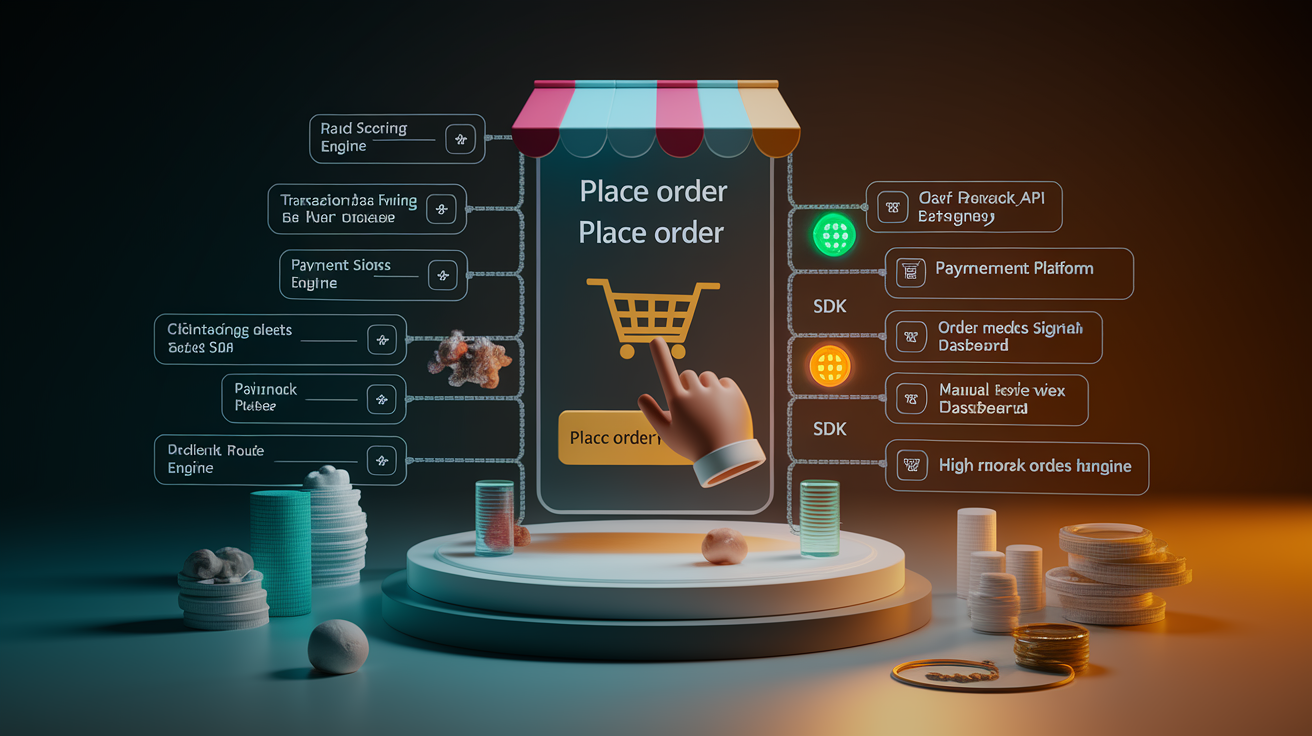
Integrating machine learning fraud scoring into production ecommerce payment systems takes coordination between the scoring engine, payment gateway, order management platform, and manual review tools. The most common integration pattern is synchronous pre-authorization scoring: when a customer clicks “Place Order,” the checkout system sends transaction details, device fingerprint, and customer history to the fraud scoring API, which returns a risk score and decision (approve/decline/review) within milliseconds. If approved, the payment gateway proceeds with authorization. If declined, the customer sees an error or gets prompted to use a different payment method. If flagged for review, the order enters a queue and the customer gets notified that their order is being verified.
Post-authorization monitoring is an alternative that reduces checkout friction. The merchant approves the transaction in real time to minimize cart abandonment, then runs fraud scoring asynchronously on the authorized order. If the post-auth score exceeds a risk threshold, the merchant can void or refund the transaction before fulfillment, limiting exposure. Webhooks deliver post-auth scores and decisions to order management systems, triggering fulfillment holds or fraud investigation workflows. This approach trades slightly increased fraud exposure for higher approval rates and better customer experience.
SDK-based client-side signal collection enhances scoring by capturing device fingerprints, browser metadata, and behavioral biometrics directly in the customer’s browser or mobile app. JavaScript or native SDKs send encrypted signals to the fraud scoring backend, enriching the feature set without adding latency to server-side scoring. Device intelligence vendors provide turnkey SDKs that handle signal collection, encryption, and integration with scoring APIs.
Integration approaches for production fraud scoring:
Synchronous pre-authorization API: Checkout calls scoring API before payment authorization, receives approve/decline/review decision in <100 ms.
Asynchronous post-authorization webhooks: Approve transaction immediately, score in background, void or flag high-risk orders before fulfillment.
Client-side SDK signal collection: Capture device fingerprints, behavioral biometrics, and session data in browser or app, send to backend for scoring.
Manual review UI integration: Embed fraud scores, feature explanations, and transaction history in reviewer dashboards to speed up decisions.
Rule engine augmentation: Combine ML scores with business rules, allow/deny lists, and compliance checks in a unified decisioning engine.
Merchant feedback loops improve model accuracy over time. Reviewers label queued transactions as fraud or legitimate, and their decisions become high-confidence training examples. Chargeback data flows back into the model pipeline, enabling automated retraining on confirmed fraud cases. SLA requirements often specify that scoring APIs respond within 50 milliseconds at the 95th percentile and stay available with 99.9 percent uptime to avoid payment failures or degraded customer experience during peak traffic.
Final Words
We defined fraud scores as numeric risk indicators built from signals like address match, BIN-to-billing-country alignment, IP-to-billing distance, proxy detection, and email age. They don’t make decisions, they feed ML models, thresholds, and reviewer queues.
We covered real-time needs (sub-100 ms), common models (GBDT, neural nets, graph analytics), feature engineering, label delays, and threshold tuning to balance approval rate and chargebacks.
Use fraud scoring and machine learning models for ecommerce payments as your foundation: capture the right signals, test thresholds, and route borderline cases to review. Do that, and you’ll reduce fraud while keeping approvals healthy.
FAQ
Q: What is fraud scoring in ecommerce payments?
A: Fraud scoring in ecommerce payments is a numeric risk indicator that ranks transactions to approve, decline, or route for review, feeding thresholds, ML models, and reviewer queues rather than making the final decision itself.
Q: What inputs typically feed a fraud score?
A: The inputs for a fraud score include address match, BIN-to-billing country alignment, IP-to-billing distance, proxy/VPN detection, device fingerprinting, and identity signals like email age and phone age.
Q: How are fraud scores used to decide approve, decline, or review?
A: Fraud scores are used to decide by applying business thresholds: auto-approve high scores, auto-decline low scores (for example score <12), and route borderline scores to manual review or additional checks.
Q: Which machine learning models are commonly used for fraud scoring?
A: Common models for fraud scoring include gradient boosting (XGBoost, LightGBM), random forests, logistic regression baselines, neural networks for sequences, graph models for collusion, and autoencoders for anomaly detection.
Q: How does real-time ML scoring work and what latency is required?
A: Real-time ML scoring works by ingesting streaming features into a feature store, running lightweight models (often tree-based) on model servers, and returning scores within sub-100 ms to avoid checkout friction.
Q: How should teams handle labels and class imbalance when training fraud models?
A: Teams handle labels and imbalance by using confirmed chargebacks and investigations as ground truth, applying oversampling/undersampling or class weights, and using time-based splits to prevent leakage while accounting for label delays.
Q: What metrics and methods evaluate fraud scoring performance and thresholds?
A: Evaluating fraud scoring uses precision, recall, FPR, FNR, AUC-ROC, and precision@k, plus business KPIs like approval rate and chargeback rate; expected-loss calculations help pick cost-sensitive score thresholds.
Q: How can merchants reduce false positives and manage manual review workflows?
A: Merchants reduce false positives by creating calibrated score bands (auto-approve, review, decline), using hybrid rules plus ML, prioritizing high-value reviews, and continuously tuning reviewer routing and feedback loops.
Q: Which feature categories are most important for transaction risk scoring?
A: Important feature categories are transaction details (amount, items), identity attributes (email age), device/browser fingerprints, network/IP intelligence (ASN, proxy), behavioral patterns (velocity), and merchant-specific aggregates.
Q: What are deployment and monitoring best practices for scoring systems?
A: Deployment and monitoring best practices include shadow/canary releases, A/B tests, drift detection (alert on PSI > 0.2), feature distribution checks, and monitoring approval rate and chargeback spikes in real time.
Q: How are fraud scores integrated into existing payment systems?
A: Fraud scores integrate via synchronous pre-authorization scoring, post-authorization webhooks, SDK-based device signal collection, manual-review UIs, and merchant feedback loops to improve model precision over time.
Q: What real-world fraud problems can ML scoring detect?
A: ML scoring detects CNP fraud, account takeover, card-testing attacks, BNPL abuse, friendly fraud and chargeback fraud, bot-driven checkout attacks, and fraud rings identified via graph signals.