


What if chasing thousands of leads is why you keep losing the big B2B deals?
Account-based marketing flips that script: pick the handful of companies that matter, align sales and marketing, and run hyper-personalized campaigns that treat each account like a market.
This approach raises close rates, speeds up cycles, and directs budget to real revenue opportunities.
In this post you’ll get clear ABM strategies for choosing target accounts, mapping stakeholders, building tailored content, and launching coordinated outreach so you can win high-value clients without wasting ad spend.
Core Explanation of Account-Based Marketing

Account-based marketing flips the usual B2B playbook. Instead of chasing thousands of leads, you’re treating a handful of high-value companies like they’re entire markets. You pick the accounts that matter most, the ones with real revenue potential, and then marketing and sales stop working in silos. They team up to research each target, map out who makes decisions, and build campaigns that feel personal across every channel. The point isn’t to fill a funnel with strangers. It’s to move whole accounts forward.
ABM doesn’t look anything like traditional demand gen. Regular marketing wants volume, big demographic buckets, generic webinars that pull in 500 email addresses. ABM builds a custom industry report for three CFOs at three companies, follows up with personalized mail, and sends one-to-one LinkedIn messages. Fewer prospects. Way higher deal values. Better close rates. And the sales cycle gets shorter because you’re not wasting time on early qualification. Accounts get qualified before you launch anything.
You adopt ABM when your business depends on landing big enterprise deals, not high-velocity transactions. Think software vendors selling six-figure contracts, consulting firms chasing Fortune 500 relationships, tech providers fighting for space in crowded enterprise markets. It works best when your ideal customer profile is narrow, your average deal size can justify the effort, and your sales team can actually coordinate with marketing on account plans.
Why businesses use account-based marketing:
- Efficiency: You’re spending on accounts that have budget, need, and real decision-maker access. Not just random traffic.
- Personalization: Every message reflects the account’s industry problems, their tech stack, what their leaders care about.
- Alignment: Sales and marketing share one account list. No more arguments about lead quality.
- ROI: Eighty-four percent of companies using ABM see better returns than other campaigns. Money goes to proven opportunities.
- Speed: Pre-qualified accounts and coordinated outreach cut down sales cycles. You skip the cold prospecting phase entirely.
Key Types of Account-Based Marketing Approaches

Strategic ABM, sometimes called one-to-one, puts the most effort into a tiny list of named accounts. Usually one to five companies that could change your revenue picture completely. Each one gets its own research, custom content, tailored events, executive engagement. A single account might take weeks of planning, involve your own C-suite, pull in product teams and sales engineers. This works for seven-figure deals or partnerships that unlock entire segments.
ABM Lite, the one-to-few version, groups small clusters of accounts that share traits. Same industry, similar size, matching regulatory headaches, comparable technology setups. You don’t build everything from scratch for each company. Instead, you create semi-customized frameworks that address shared pain points, then personalize the details at the account level. Case studies, messaging, channel tactics get adjusted. A cluster might be eight to fifteen healthcare payers in the mid-market, all dealing with the same compliance deadline. This balances personalization with production reality and scales better than pure one-to-one.
Programmatic ABM, or one-to-many, uses tech and automation to deliver personalized experiences across hundreds or thousands of accounts at once. Marketing teams build dynamic content libraries, deploy account-based ad platforms, use intent data to trigger messaging. Personalization happens through variables, segmentation rules, algorithmic recommendations. Not manual work. Programmatic ABM fits horizontal plays, selling to all SaaS companies with 50 to 200 employees, for instance. Individual accounts justify targeted outreach but not the labor load of strategic ABM.
Building an Effective ABM Strategy

Picking the right accounts is everything. It takes more work than traditional lead scoring. Start by analyzing your current customer base. Find patterns in lifetime value, how fast they expanded, product adoption, churn risk. Look for accounts that closed quickly, bought multiple products, referred others, grew their contract year over year. Use those signals to build an ideal customer profile that balances firmographics (industry, revenue, headcount, location) with behavioral stuff like tech stack, recent funding, leadership changes, regulatory triggers. Sales has to co-own this list. Marketing can’t decide alone which companies deserve ABM investment.
Aligning teams means more than a single kickoff. Marketing and sales need shared definitions of what an engaged account looks like, agreed handoff points, joint accountability for pipeline from target accounts. Set up a regular rhythm, weekly or biweekly, where both sides review account movement, share new intelligence, adjust tactics. Store all research, stakeholder maps, campaign plans in one place. Your CRM, a shared board, pinned docs. Without this discipline, sales keeps working their own lists while marketing runs campaigns into empty space.
Building tailored messaging starts with the reality that different people at the same account care about totally different things. A CFO evaluates cost and budget predictability. A CIO weighs integration complexity and vendor risk. A line-of-business leader wants speed to value and team adoption. Good ABM campaigns develop distinct value propositions for each persona, backed by role-specific content and proof. Don’t just swap logos and company names into a generic deck. Real personalization references the account’s public initiatives, competitive pressures, tech choices, recent announcements.
Organizing account insights needs a system to capture and surface intelligence as it piles up. Build lightweight profiles that document key initiatives, known pain points, technology environment, buying committee, past interactions, competitive relationships. Update these every time a rep takes a meeting, a prospect visits your site, or new funding or leadership news drops. Over time, this becomes institutional memory. It stops your team from asking the same discovery questions twice and lets you run sophisticated multi-quarter nurture plays.
Steps for Implementing Account-Based Marketing

ABM follows a repeatable sequence. Selection through execution to measurement. Skip steps or rush to tactics before alignment is ready and you’ll get disappointing results. You’ll also burn credibility with sales.
1. Choose target accounts. Work with sales leadership to build a shortlist of 10 to 50 named companies that meet your ideal customer profile and represent real pipeline opportunities over the next 6 to 18 months. Make sure each account has an urgent need you can solve and a budget big enough to hit your target deal size. Cut aspirational accounts that lack intent signals or accessible entry points.
2. Research and map stakeholders. Identify the buying committee at each target by role, name, influence. Typical B2B purchases involve six to ten decision-makers across procurement, finance, IT, operations, business units. Use LinkedIn Sales Navigator, intent data platforms, manual research to build org charts. Show reporting relationships and likely project sponsors. Understand each person’s priorities, recent activity, content habits.
3. Develop personalized content and messaging. Create account-specific assets that speak to the challenges and objectives you found during research. Custom one-pagers, industry benchmark reports, tailored demo environments, executive briefings, video messages from your leadership. Templatize where you can. Build modular blocks that mix and match. But make sure every final deliverable feels purpose-built.
4. Plan channel mix and sequence. Map the most effective channels for reaching each stakeholder tier. Senior execs may respond better to peer intros, private events, direct mail. Mid-level managers engage through LinkedIn, email sequences, webinars. Coordinate timing so multiple touchpoints land in a compressed window. Create a surround-sound effect that signals serious intent and organizational commitment.
5. Execute coordinated campaigns. Launch multi-channel outreach with sales and marketing in lockstep. Marketing runs LinkedIn Sponsored Content and personalized display ads while sales sends tailored emails and requests intros through mutual connections. Host small executive dinners, send thoughtful direct mail, publish custom research, create dedicated landing pages that reflect each account’s brand and priorities. Track every interaction in your CRM so both teams see engagement in real time.
6. Measure, iterate, and scale. Monitor account-level engagement, meeting rates, opportunity creation, pipeline velocity. Not vanity metrics like email open rates. Give the program enough time to generate results, usually one to two full sales cycles, before judging success. Identify which tactics and messaging drove the most movement, refine your playbook, expand to the next tier of accounts. ABM improves through repeated cycles, not one-time campaigns.
ABM Tools and Technology Stack

ABM platforms cut down the manual work of account identification, personalization, measurement. The stuff that would otherwise live in spreadsheets, tribal knowledge, heroic coordination efforts. The best tools sit where data enrichment, campaign orchestration, and sales intelligence meet. They give marketing and sales a shared view of account engagement and intent signals. Modern ABM stacks integrate directly with your CRM and marketing automation platform so account insights flow into systems where reps and marketers already work.
Identification tools help you discover which companies are visiting your site, researching your category, showing intent signals across the web. These platforms match anonymous IP addresses and digital activity to named companies, then score accounts based on engagement intensity, firmographic fit, technographic signals like tech stack or recent funding. Some maintain datasets covering 60 million companies and 400 million contacts worldwide. They offer filters to prioritize accounts meeting your ICP and reveal up to 45 percent of site visitors by company name.
Engagement and personalization tools let you deliver tailored experiences at scale. Web personalization, dynamic content, account-based advertising, coordinated outreach sequences. These platforms let marketers serve different homepage messaging to visitors from target accounts, build custom landing pages that reference the visitor’s company and industry, orchestrate multi-touch campaigns across email, social, display, direct mail. Sales teams use the same platforms to trigger alerts when target accounts hit key engagement thresholds, access suggested talking points, track which content resonates with specific stakeholders.
Core capabilities to look for in an ABM platform:
- Account discovery and scoring: Surface high-fit accounts visiting your site and rank them by engagement and ICP alignment.
- Buying committee identification: Map decision-makers and influencers within target accounts using org charts and contact data.
- CRM and MAP integration: Sync account lists, engagement data, campaign results bidirectionally with Salesforce, HubSpot, similar systems.
- Analytics and attribution: Track account progression, influenced pipeline, revenue impact at the account level. Not lead level.
Measuring Account-Based Marketing Success

ABM measurement doesn’t look like traditional demand gen because the unit of analysis changes. From individual leads to entire accounts. Lead volume, form fills, MQL counts become almost irrelevant. What matters is whether target accounts are engaging, whether buying committees are expanding their interactions, whether those accounts turn into pipeline and closed revenue. This requires new reporting infrastructure and a willingness to accept smaller absolute numbers in exchange for higher conversion rates and deal values. Marketing teams used to celebrating thousands of monthly leads have to recalibrate and explain to executives why 20 deeply engaged target accounts beat 2,000 cold form fills.
The metrics that actually matter track account movement and revenue impact over time. Account engagement scores combine all touchpoints (site visits, content downloads, ad impressions, email opens, event attendance, sales meetings) across every known contact within a target account. Account progression rate measures how many targets move from awareness to active opportunity within a set period, usually 90 to 180 days. Deal velocity and sales cycle length show whether ABM shortens time from first touch to closed-won by cutting early qualification friction. Customer acquisition cost relative to lifetime value shows whether the extra investment in personalization and coordination pays off in larger contracts, faster expansion, lower churn. Win rates and conversion percentages at each stage prove whether ABM improves close rates on the opportunities it influences.
| Metric | What It Measures | Why It Matters |
|---|---|---|
| Account engagement score | Cumulative interactions across all contacts within a target account over a rolling period | Shows whether your campaigns are reaching and resonating with the buying committee, not just a single contact |
| Influenced pipeline | Dollar value of opportunities created from target accounts that engaged with ABM campaigns | Connects marketing activity directly to revenue potential and justifies continued ABM investment |
| Sales cycle length | Days from first meaningful engagement to closed-won for ABM-sourced deals versus non-ABM deals | Quantifies whether pre-qualification and coordinated outreach compress the buying process |
| Account penetration | Number of net-new contacts added per target account and percentage of identified buying committee engaged | Measures whether you are expanding relationships beyond a single champion into true enterprise consensus |
Real-World ABM Examples
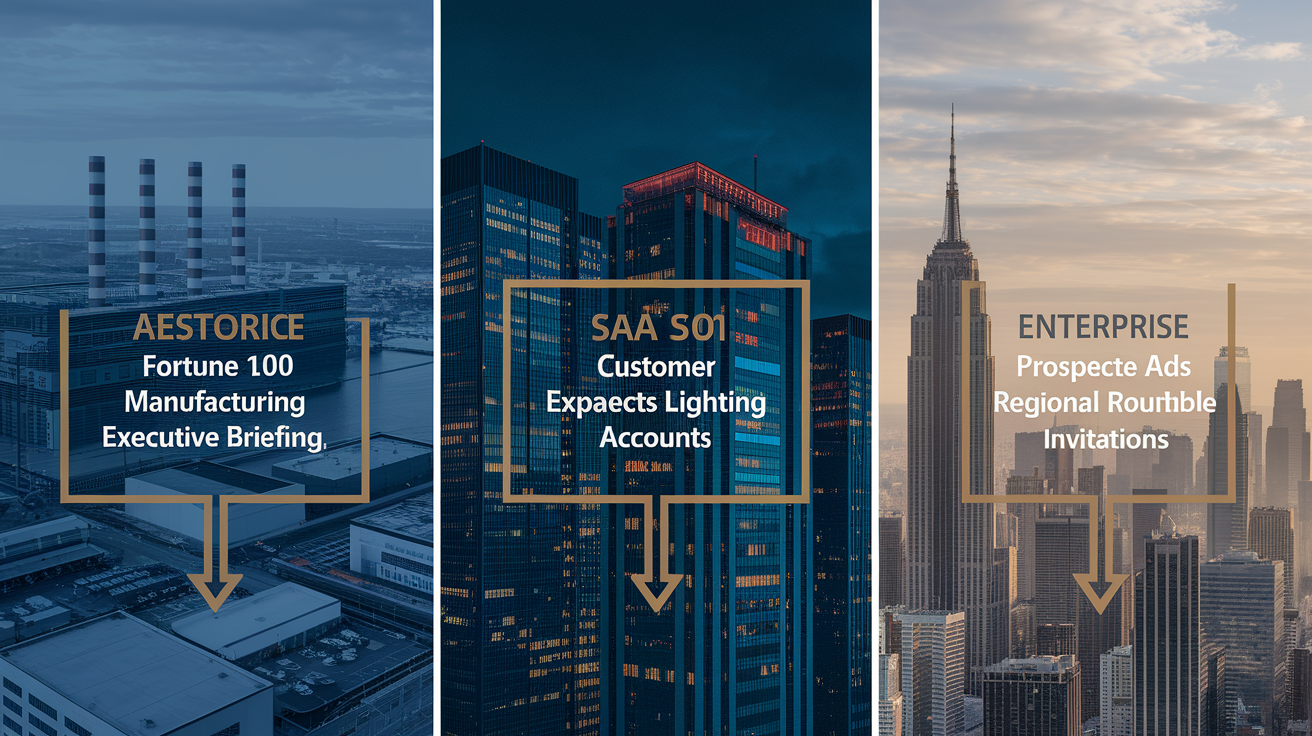
A global enterprise software company used strategic one-to-one ABM to close a Fortune 100 manufacturing account that hadn’t responded to traditional outreach for three years. The ABM team built a custom microsite with industry-specific ROI calculators, commissioned an analyst report on digital transformation challenges in manufacturing, coordinated a private executive briefing with the prospect’s CIO and CFO. Sales engineering created a tailored proof-of-concept environment pre-loaded with the account’s own data structures. After six months of coordinated touchpoints, the account entered active evaluation. The deal closed at $2.3 million annual contract value, more than double the company’s average enterprise sale.
A mid-market SaaS provider applied ABM lite to expand revenue within existing customers by targeting accounts that had only adopted one product line. The company clustered 40 customers by industry and use case, then developed vertical-specific case studies, ROI frameworks, integration guides for each cluster. Customer success managers and account executives co-delivered personalized webinars, shared executive business reviews, ran limited-time incentive campaigns tied to cross-product adoption. Over 12 months, 18 of the 40 target accounts expanded into additional product lines. That contributed $1.8 million in net-new recurring revenue and cut churn risk by deepening product integration.
A consulting firm used programmatic ABM to re-engage 200 dormant enterprise prospects that had gone cold after initial discovery meetings. The firm uploaded the account list to an ABM advertising platform, then served personalized display ads and LinkedIn Sponsored Content featuring new client success stories, updated service offerings, invitations to small regional roundtables. At the same time, business development reps sent tailored email sequences referencing earlier conversations and highlighting relevant market shifts. The campaign generated 27 reactivated opportunities, 9 closed projects, $4.1 million in booked revenue. Proof that ABM works for reactivation, not just net-new acquisition.
Final Words
You saw a tight definition of account-based marketing, the three ABM models (one-to-one, one-to-few, one-to-many), and a practical ABM strategy: pick accounts, align teams, tailor messages, map decision-makers. We walked through six implementation steps, essential tools, and the right KPIs, plus real-world examples.
If you run B2B growth, this gives a ready checklist to test and scale.
Start small, measure account engagement, iterate fast, account based marketing can shorten sales cycles and lift ROI. You’ve got this.
FAQ
Q: What is meant by account-based marketing?
A: Account-based marketing means targeting specific high-value B2B accounts with coordinated, personalized marketing and sales actions to increase relevance, speed up deals, boost conversion, and improve ROI compared with broad lead generation.
Q: What is an example of account-based marketing?
A: An example of account-based marketing is running a tailored campaign for one enterprise: personalized landing pages, targeted LinkedIn ads to decision-makers, bespoke sales outreach and demos, and coordinated content to close the deal.
Q: What is the 3 3 3 rule in marketing?
A: The 3-3-3 rule in marketing is a planning heuristic: three core messages delivered across three channels with three touches per audience segment to build familiarity and prompt action. Variations exist by industry and goals.
Q: How do you do account-based marketing?
A: You do account-based marketing by selecting high-value accounts, aligning sales and marketing, mapping decision-makers, creating tailored content, running coordinated multi-channel outreach, tracking account engagement, and iterating from revenue signals.