

Think fixing one warning keeps your Amazon account safe? Think again.
Amazon’s 2026 seller performance policy tightens ODR, LSR, VTR, RDR, and listing rules, and automation now enforces penalties faster and with less human review.
That means suspensions, Buy Box loss, or listing suppression can happen within hours, and revenue follows quickly.
This post breaks down what changed, who gets hit, and practical action steps you can run today to stop small issues from becoming account-level failures.
Immediate 2026 Policy Changes Affecting Amazon Seller Performance Standards

Amazon’s 2026 seller performance updates just got tighter. The platform’s weighing buyer response time and return processing way more heavily now, and automated enforcement kicks in faster across every performance area. These changes build on the automated handling time overrides from September 25, 2024, and those 200-character title limits that started January 21, 2025. Miss these shifts and you’ll see warnings escalate to suppression or suspension faster than before.
The enforcement posture for 2026 is all about proactive measurement. Amazon’s systems cross-reference performance metrics in real time. A spike in late shipments can trigger automated listing suppressions or Buy Box removal within hours. Your account health score reflects a composite view: order defect rate, late shipment rate, pre-fulfillment cancellations, valid tracking rate, and return dissatisfaction rate get monitored continuously. Thresholds are enforced through automation, not manual review.
This directly connects to overall account health scoring by cutting human discretion out of penalty decisions. Sellers approaching any threshold get escalating notifications through the Seller Central dashboard and email, but the timeline from warning to enforcement action just got shorter. The system treats repeat or concurrent threshold breaches as proof of systemic failure, which speeds up the path to suspension and forces you to submit documented corrective action to get selling privileges back.
Five 2026 updates you can’t ignore:
Expanded ODR calculation now includes negative feedback responses, credit card chargebacks, and A-to-z Guarantee claims in the defect count.
LSR enforcement threshold formally set below 4%. Sellers are getting suspended for exceeding this rate even after submitting action plans.
Automated listing suppression triggered by low-resolution images, missing alt text, or incomplete product attributes. Buy Box eligibility now requires 80% attribute completeness.
Return processing efficiency integrated into account health scoring. Refunds expected within 48 hours of receipt, and buyer messages answered within 24 hours every single day.
Automated handling time overrides replace seller-entered handling times with platform-calculated values based on actual fulfillment history, directly affecting LSR calculations.
Breakdown of 2026 Amazon Seller Performance Metrics and Their Enforcement Impact

Order Defect Rate (ODR)
Order defect rate measures the percentage of orders with one or more defects: negative feedback, an A-to-z Guarantee claim, or a credit card chargeback. Amazon’s 2026 calculation explicitly includes all three types in the numerator, divided by total orders in the evaluation period. You’ve got to maintain ODR below 1% to avoid warnings, Buy Box removal, or account suspension. One seller whose ODR jumped from under 1% to 1.7% watched daily sales collapse from 40–60 units to 8–11 units. That’s the immediate revenue hit when you breach the threshold.
Late Shipment Rate (LSR)
Late shipment rate tracks the percentage of orders confirmed shipped after the expected ship date. The 2026 threshold sits below 4%. Any seller with LSR at or above 4% faces formal warnings and potential suspension. Sellers are reporting account suspensions triggered by LSR violations even when they submitted action plans, which shows automated enforcement now overrules discretionary review in most cases.
Pre-Fulfillment Cancellation Rate (PFCR)
Pre-fulfillment cancellation rate measures seller-initiated cancellations before shipment, divided by total orders. The threshold for 2026 stays at 2.5%, but automated enforcement got tighter. Cancellations from inventory errors, pricing mistakes, or stockouts all count toward this metric. Repeated threshold breaches trigger listing suppressions or loss of seller-fulfilled offer eligibility.
Valid Tracking Rate (VTR)
Valid tracking rate calculates the percentage of shipments with working, customer-accessible tracking numbers. You need at least 95% VTR to avoid penalties. Tracking numbers that don’t update, are invalid, or route to carrier error pages count as invalid. Low VTR directly reduces Buy Box eligibility and can lead to listing suppression if the rate drops significantly below 95%.
Return Dissatisfaction Rate (RDR)
Return dissatisfaction rate measures negative buyer experiences during the returns process, expressed as a percentage of total return requests. Amazon’s 2026 threshold is 10%. While RDR isn’t currently an immediate suspension trigger, it harms account health, reduces Buy Box chances, and signals poor post-sale service. High RDR combines with other metric violations to speed up enforcement actions.
| Metric | 2026 Threshold | Enforcement Trigger |
|---|---|---|
| Order Defect Rate (ODR) | <1% | Buy Box removal, account suspension, listing suppression |
| Late Shipment Rate (LSR) | <4% | Formal warning, account suspension |
| Pre-Fulfillment Cancellation Rate (PFCR) | <2.5% | Listing suppression, loss of seller-fulfilled eligibility |
| Valid Tracking Rate (VTR) | ≥95% | Buy Box removal, listing suppression |
| Return Dissatisfaction Rate (RDR) | <10% | Reduced Buy Box eligibility, account health degradation |
Updated 2026 Listing & Product Compliance Rules Tied to Seller Performance
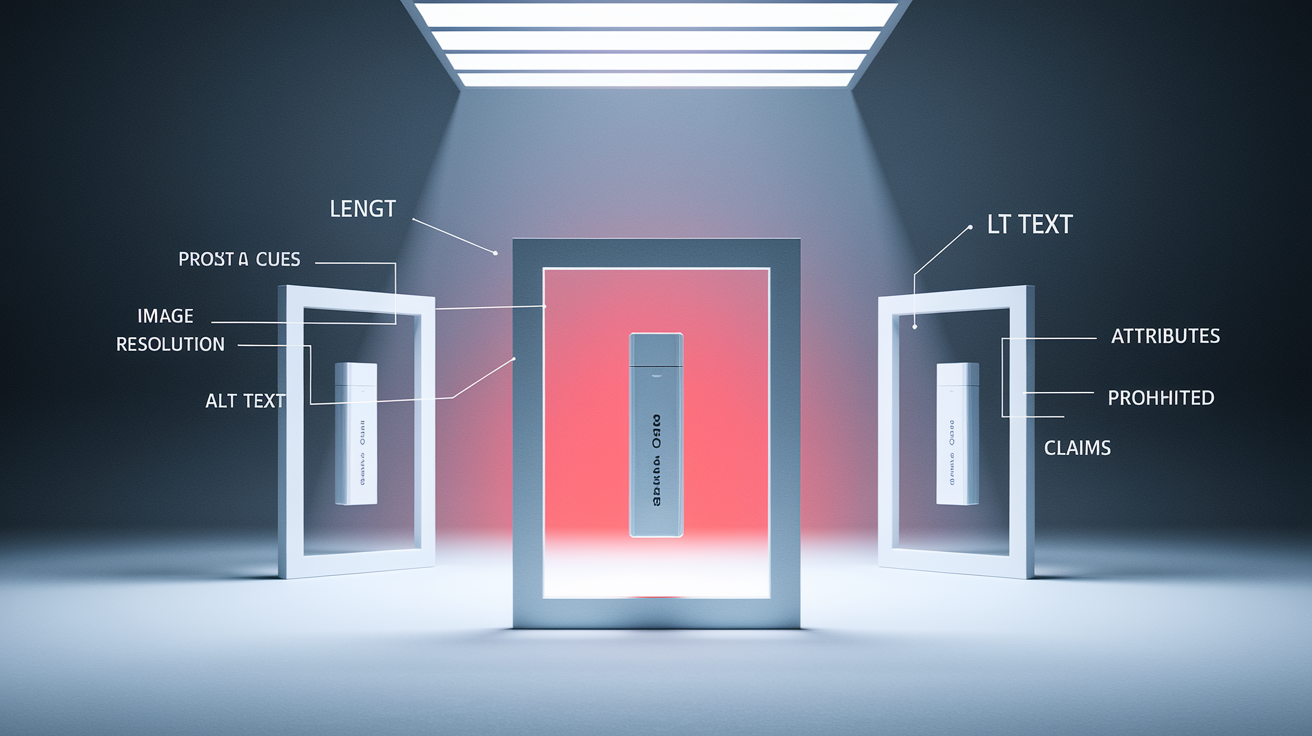
Listing quality violations now trigger automated suppression within hours, directly hitting your performance scores and revenue. Amazon’s 2026 rules enforce a 200-character limit on product titles (including spaces), prohibit certain special characters, and restrict repeating the same word more than twice unless it’s an article, conjunction, or preposition. Main images need a pure white background (RGB 255,255,255) with the longest side between 500 and 1,000 pixels to enable zoom. Formats are limited to JPEG, TIFF, PNG, or non-animated GIF. Low-resolution images or listings missing required visual elements face immediate suppression, removing the ASIN from search results and Buy Box consideration until you fix it.
Buy Box eligibility in 2026 requires at least 80% of product attributes to be complete. Required attributes include material composition, dimensions, usage instructions, and category-specific fields. Over 50% of customers base purchase decisions on image quality, so missing supplementary images, absent alt text, or non-compliant main images directly reduce conversion even when listings stay live. Bullet points must include at least three clear features for readability. You can’t make health, safety, or regulatory claims like “FDA approved,” “cures,” or “diagnostic” without proper documentation. Violating these content rules results in listing removal and can escalate to account-level warnings if violations are widespread or repeated.
Most common listing violations in 2026:
Title length exceeding 200 characters or including prohibited special characters and excessive word repetition.
Main image non-compliance like non-white backgrounds, logos, watermarks, or text overlays that violate Amazon’s image guidelines.
Incomplete product attributes falling below the 80% completeness threshold required for Buy Box eligibility.
Low-resolution or missing supplementary images that prevent customers from viewing product details or cause automated quality checks to fail.
Unverified health, safety, or performance claims in titles, bullets, or descriptions that trigger content-policy violations.
Missing alt text on main or supplementary images, reducing accessibility compliance and triggering automated listing quality flags.
2026 Fulfillment, Shipping, and Inventory Policies Influencing Performance Metrics

Fulfillment mistakes directly increase late shipment rate, pre-fulfillment cancellation rate, and return dissatisfaction rate. Inventory and shipping accuracy are critical to maintaining account health in 2026. Amazon introduced transit time caps on August 25, 2024, and began automated handling time enforcement on September 25, 2024. The platform now overrides manually entered handling times if actual fulfillment history shows faster or slower performance. Set your handling time to one day but consistently ship in three? Amazon automatically adjusts your promises to match reality. That causes delivery date expectations to shift and increases the risk of late shipments when fulfillment slows even slightly.
FBA multi-pack and case-pack rules tightened in 2026. Every unit within a multi-pack must carry a scannable label. Case-pack dimensions must match Amazon’s records exactly. Mismatches cause receiving delays, inventory holds, or disposal without reimbursement. Storage limits are now directly tied to the Inventory Performance Index. High performers get extra storage allocation during peak seasons. Underperformers face tighter caps. Slow-moving inventory triggers early warnings, and long-term storage fees apply faster than in prior years. You need to audit inventory age weekly and remove or discount stagnant SKUs before fees compound.
Return dissatisfaction rate and late shipment rate spike when sellers rely on inconsistent carriers or fail to upload tracking at the moment of label printing. Valid tracking rate requires working, customer-accessible tracking numbers for at least 95% of shipments. Any delay between label creation and tracking upload counts against VTR. Automated systems flag listings with poor carrier performance or frequent tracking gaps, reducing Buy Box eligibility even when ODR stays low.
To align fulfillment with 2026 policies:
- Audit handling time settings weekly and compare promised ship dates against actual dispatch times to detect drift before Amazon overrides settings.
- Label every unit in multi-packs with scannable barcodes and verify case dimensions match Amazon’s inbound requirements to avoid receiving delays or disposal.
- Monitor inventory age and IPI score monthly to identify slow-moving SKUs and trigger markdowns or removal orders before long-term storage fees apply.
- Upload tracking numbers immediately at label print or dispatch to maintain VTR above 95% and avoid Buy Box removal.
Amazon’s 2026 AI Automation & SP‑API Compliance Rules That Affect Seller Performance

Amazon’s March 4, 2026, automation policy update introduced mandatory SP-API registration and explicit prohibitions on browser automation, screen scraping, and undocumented API usage for all seller tools that execute decisions without real-time human input. The policy included a 90-day transition window ending in June 2026. After that, enforcement became active. Sellers using legacy repricing or inventory tools that relied on scraped competitor data or browser automation now face ASIN suppression, API access suspension, or full account deactivation if those tools remain in use.
Automated pricing rules impose a 20% daily price change cap. Any net automated price adjustment exceeding 20% within a 24-hour window is a violation, even if the change results from multiple small updates. Manual human price updates are exempt from the 20% cap but still must follow general pricing rules. All competitor pricing data used in automated workflows must come from the Product Advertising API, which requires its own registration and rate-limit compliance. Repricing faster than SP-API rate limits allow or using prohibited inputs triggers listing suppression. You’ve got to implement exponential backoff and throttling safeguards to stay compliant.
Bulk listing automation faces a 500-ASIN human review gate. Fully automated workflows must route tier-three actions (like bulk listings exceeding 500 ASINs, automated price changes over 20% in 24 hours, or account configuration changes) to documented human authorization. Restricted-category listings always require human review regardless of batch size. Sellers must maintain retrievable audit logs for every automated action, including timestamp, action type, input data, and output. Retain those logs for at least 12 months. Non-compliance risks ASIN suppression affecting all listings tied to the same tool, API token revocation (with reinstatement requiring a Plan of Action and typically taking two to four weeks), or account deactivation for repeated or willful violations.
Performance suspension risk tied to automation in 2026:
SP-API registration mandatory for all automated actions. No exceptions. Unregistered tools trigger immediate enforcement.
20% daily automated price change limit enforced at the net change level. Threshold breaches cause listing suppression and require human review.
500-ASIN bulk listing threshold requires documented human approval before execution, preventing runaway automation errors.
12-month audit log retention with tamper-evident storage, required for appeals and compliance audits.
Prohibition of browser automation and scraping with enforcement through ASIN suppression, API suspension, or account deactivation for legacy tools not updated after June 2026.
Step-by-Step 2026 Amazon Compliance Workflow for Protecting Account Health

Maintaining account health in 2026 requires daily, weekly, and monthly operational routines that prevent metric threshold breaches before they trigger automated enforcement. You must respond to all buyer messages within 24 hours every day, including weekends and holidays. Process refunds within 48 hours of return receipt to avoid increases in order defect rate and return dissatisfaction rate. Weekly audits of ODR, LSR, PFCR, VTR, and RDR aren’t optional. Escalate to daily monitoring when any metric approaches its threshold, like ODR nearing 1%, LSR nearing 4%, or VTR dropping toward 95%.
Short-term compliance steps span 7–30 days and focus on listing accuracy and operational setup. Audit all active listings for title character limits, prohibited claims, image compliance (white background, resolution, alt text), and accurate product descriptions covering materials, dimensions, and compatibility. Configure automated tracking uploads so tracking numbers are sent to Amazon at the moment of label print or dispatch. That keeps VTR above 95%. Set or update safety stock thresholds and buffer levels to reduce pre-fulfillment cancellations caused by unexpected demand spikes or supplier delays.
Medium-term actions within 30–90 days include compiling, scanning, and submitting required product compliance documents for categories that mandate pre-listing approval, like children’s products, electrical items, or health-related goods. Align handling time settings with actual fulfillment performance to prevent automated overrides. Retest the handling-to-ship cadence and adjust settings to match operational reality. Monthly and quarterly compliance reviews ensure corrective actions remain effective and that new policy updates get incorporated into workflows as Amazon announces changes at quarterly seller conferences or via Seller Central communications.
The operational roadmap for 2026 compliance includes these seven steps:
- Monitor the Seller Central performance dashboard daily for ODR, LSR, PFCR, VTR, and RDR. Escalate to real-time checks if any metric nears its threshold.
- Respond to all buyer messages within 24 hours every day of the week, including holidays, to prevent negative feedback and A-to-z claims that increase ODR.
- Process refunds within 48 hours of return receipt to maintain low RDR and avoid chargebacks or buyer dissatisfaction claims.
- Audit all active listings within 7–30 days for title compliance (≤200 characters), image quality (white background, resolution, alt text), attribute completeness (≥80%), and accurate descriptions.
- Configure automated tracking uploads so tracking numbers are sent at label print or dispatch, maintaining VTR ≥95% and avoiding Buy Box removal.
- Submit product compliance documents within 30–90 days for any categories requiring pre-listing approval, and align handling time settings with actual fulfillment performance to prevent automated overrides.
- Conduct monthly compliance reviews to verify corrective actions are effective, document metric trends, and prepare evidence logs (timestamps, tracking, refunds) for appeals if suspensions occur.
Navigating 2026 Amazon Appeals, Plan of Action Requirements, and Reinstatement Timelines

Recovering from suspensions caused by 2026 performance violations requires a structured Plan of Action that addresses root cause, corrective action, and preventive systems in clear, factual language. Amazon reviews POAs for API suspensions and account deactivations within platform timelines, typically taking two to four weeks for API reinstatement and longer for account-level suspensions. You’ve got to avoid vague promises or generic statements like “We will do better” or “We have fixed the issue.” Instead, provide specific, verifiable steps that show systemic improvements.
The POA structure must start with a precise root-cause analysis. Identify the exact policy violation, the operational failure that caused it, and the timeframe during which the violation occurred. Corrective action follows, detailing every step already taken to resolve the immediate issue, including timestamps, tracking numbers, refunds processed, inventory adjustments made, or listings updated. Preventive systems close the POA by describing new workflows, monitoring tools, staff training, or software changes that will prevent recurrence. Include screenshots, audit logs, carrier receipts, and inventory reports to strengthen your appeal with concrete evidence rather than assertions.
Evidence collection for 2026 appeals must be comprehensive and timestamped. Maintain daily logs of performance metrics, buyer messages, refund transactions, and inventory adjustments. Store them in tamper-evident formats that can be exported and attached to appeals. When an ASIN suppression, API suspension, or account deactivation occurs, immediately compile all relevant data: order IDs, tracking confirmations, message timestamps, and policy-compliance screenshots. Organize them into a narrative that shows Amazon the violation was isolated or has been fully remediated.
Required evidence for 2026 appeals:
Timestamped logs of all corrective actions taken after the violation was identified, including message responses, refunds, tracking uploads, and listing edits.
Performance metric screenshots from Seller Central showing ODR, LSR, PFCR, VTR, and RDR before, during, and after the violation period.
Inventory and fulfillment records like warehouse logs, carrier receipts, label-printing timestamps, and stock adjustments that prove corrective steps were completed.
Documentation of new preventive systems including SOPs, training materials, monitoring alerts, or software configurations that prevent future threshold breaches.
Proof of policy compliance for listings or automation tools, like SP-API registration confirmations, audit log exports, or product compliance certificates submitted to Amazon.
Monitoring Tools, Dashboards, and Automation for 2026 Performance Compliance

Building a reliable monitoring system prevents performance violations before automated enforcement removes listings or suspends accounts. Check performance metrics weekly as a baseline. Escalate to daily monitoring when any metric approaches its threshold: ODR near 1%, LSR near 4%, PFCR near 2.5%, or VTR near 95%. Automated alerts for ODR and LSR spikes enable real-time response, letting you pause new orders, expedite shipments, or escalate carrier issues before thresholds get breached. Anomaly detection tools flag unusual patterns in order defects, tracking gaps, or return rates, signaling operational drift that requires immediate investigation.
Image quality audits, attribute completeness reports, and SKU-level FBA inventory age reports should run at least monthly to prevent listing suppressions and long-term storage fees. Prioritize fixing listings that impact Buy Box eligibility, starting with high-velocity SKUs to preserve revenue while remediating lower-volume products. Logs of corrective actions and metric trends should be retained for at least 12 months in formats that support appeals, including CSV exports, screenshots, and carrier confirmations.
| Tool Type | 2026 Use Case | Monitoring Frequency |
|---|---|---|
| Performance dashboard alerts | Track ODR, LSR, PFCR, VTR, RDR thresholds and trigger escalation when approaching limits | Daily when near thresholds; weekly baseline |
| Listing quality audits | Check title length, image compliance, attribute completeness, and content-policy violations | Monthly for all listings; weekly for new SKUs |
| FBA inventory-age reports | Identify slow-moving SKUs and prevent long-term storage fees through early markdowns or removals | Weekly during peak seasons; bi-weekly off-peak |
| Automated tracking upload systems | Ensure VTR ≥95% by uploading tracking at label print or dispatch without manual delays | Real-time at every shipment confirmation |
Final Words
We walked straight through the new 2026 rules: what tightened, how metrics are calculated, and where listings, fulfillment, and automation now hit account health.
Main actions are simple: audit top SKUs and metrics weekly, fix titles and images to the new rules, tighten handling-time and shipping routines, and move automation onto SP‑API gates. Build weekly monitoring and a quick POA template.
Use the Amazon 2026 seller performance policy updates and compliance steps in this post as your operating checklist. You can stay compliant—and keep selling.
FAQ
Q: Will Amazon seller fees increase in 2026?
A: Seller fees may rise in 2026, but Amazon hasn’t announced a blanket hike; watch category-specific referral fee changes, FBA fulfillment-fee tweaks, and Seller Central notices—plan for modest increases in your cost model.
Q: How many Amazon sellers make over $100k?
A: Exact counts aren’t public; most Amazon sellers earn under $100k. Industry surveys show a minority exceed six figures—use recent marketplace reports and category benchmarks to set realistic revenue targets.
Q: What are the biggest FBA mistakes to avoid?
A: The biggest FBA mistakes to avoid are poor labeling and prep, inconsistent restocking, incorrect packaging or dimensions, low-res images causing suppressions, and ignoring IPI, transit-time, or handling-time rules.
Q: Why is Amazon going back to 5 days a week?
A: Amazon returning to 5 days a week is meant to standardize operations, reduce labor variability, and tighten shipping predictability—expect shifts to carrier cutoffs that can raise late-shipment and handling-time pressure.