


If your marketplace treats VAT as an afterthought, 2025 will cost you.
New EU rules expand the deemed supplier model and tighten OSS/IOSS reporting, pushing VAT liability, seller verification, and ten-year recordkeeping onto marketplaces.
That matters: platforms now face back taxes, fines, and joint liability — Italy alone has pursued roughly €1 billion from tech platforms.
This guide explains what changed, who gets hit, and the immediate steps to take: register OSS/IOSS, automate checkout validation, tighten seller onboarding, and prepare audit-ready records.
Overview of 2025 Cross-Border VAT Changes Impacting Online Marketplaces

Cross-border VAT rules kick in whenever goods or services move from one tax jurisdiction to another in a business-to-consumer sale. For online marketplaces, 2025 is a major enforcement year. It builds on the July 1, 2021 EU reforms that introduced the “deemed supplier” model and continues with tighter reporting, verification, and registration requirements across multiple jurisdictions.
The deemed supplier rule shifted VAT collection and remittance responsibility from individual sellers to marketplaces for qualifying cross-border transactions. This happens especially when non-EU sellers store inventory in EU member states and sell to consumers in other member states, or when imported goods valued below €150 arrive in the EU.
Under the deemed supplier model, marketplaces become liable for VAT on two main transaction types. First, cross-border intra-EU sales where a non-EU seller stores goods in one member state and ships to a customer in another member state. Second, import sales where goods shipped from outside the EU have an intrinsic value at or below €150.
Marketplaces must register for the One-Stop Shop (OSS) scheme to handle intra-EU cross-border VAT, or the Import One-Stop Shop (IOSS) to collect VAT on low-value imports at the point of sale. Both schemes require marketplaces to collect detailed seller and transaction data, calculate VAT at the customer’s destination rate, issue compliant invoices, and retain records for ten years.
In 2025, marketplaces operating cross-border face these core obligations:
VAT liability: Collect and remit VAT on qualifying cross-border and import sales under deemed supplier rules.
Registration: Enroll in OSS for intra-EU sales and IOSS for imports below €150. Appoint an EU intermediary if the marketplace isn’t EU-established.
Data collection: Capture and validate seller tax numbers, headquarters location, product descriptions, intrinsic values, ship-from and ship-to addresses at checkout.
Filing cadence: Submit quarterly OSS returns for cross-border sales and monthly IOSS returns for import sales.
Record retention: Maintain transaction-level records, invoices, and seller data for ten years.
Seller verification: Validate VAT numbers via VIES for B2B transactions and enforce data completeness or remove non-compliant sellers.
Reporting alignment: Reconcile internal VAT records with platform reporting under DAC7, which requires annual seller reports by January 31 for sellers earning over €2,000 or completing more than 30 transactions per year.
Marketplaces and sellers need to prepare because tax authorities are intensifying cross-checks between DAC7 platform reports and VAT filings, expanding digital reporting requirements, and pursuing retrospective claims. Italy alone has pursued roughly €1 billion in VAT from major tech platforms. Non-compliance exposes marketplaces to back taxes, interest, penalties, and joint liability with sellers. Sellers risk losing marketplace access and facing audits triggered by data mismatches.
Advantages and Disadvantages of 2025 Marketplace VAT Obligations

The 2025 marketplace VAT framework delivers real operational benefits alongside significant compliance costs. Collecting VAT at checkout removes friction for customers, who no longer face unexpected charges or delays at customs when goods arrive. For marketplaces, centralized VAT collection under OSS and IOSS can simplify multi-country operations into a single registration and filing workflow, reducing the need for sellers to register individually in each member state.
But the deemed supplier model also introduces new risks and administrative burdens. Marketplaces assume joint liability with intermediaries, must navigate ambiguous import VAT rules when IOSS isn’t used, and face penalties if seller data is incomplete or incorrect. The ten-year record retention obligation and quarterly or monthly filing cycles demand sustained infrastructure and compliance resources.
Advantages of 2025 marketplace VAT obligations:
Simplified cross-EU VAT filings via OSS quarterly returns covering all 27 member states.
Faster import clearance via IOSS when VAT is collected at checkout, reducing delivery delays and customer complaints.
Reduced seller workload. Marketplaces handle VAT calculation, collection, and remittance for qualifying sales, allowing sellers to focus on operations.
Standardized data collection across jurisdictions improves audit readiness and reduces error rates.
Better compliance consistency through centralized systems and reduced reliance on seller self-reporting.
Disadvantages of 2025 marketplace VAT obligations:
Mandatory intermediary costs for non-EU marketplaces using IOSS, who must appoint an EU-established intermediary with joint and several liability.
Complex multi-jurisdiction rules requiring different treatment for intra-EU sales (OSS), imports under €150 (IOSS), and imports over €150 (border VAT).
Ambiguous Article 201 import VAT rules when IOSS isn’t used. Member states can assign liability to the customer, deemed supplier, or underlying seller, creating uncertainty.
Invoice flow adjustments and self-billing requirements for cross-border B2B legs of marketplace transactions.
Large recordkeeping burden. Ten years of transaction-level data, invoices, and seller verification records.
For marketplaces, the trade-off is between operational simplification in certain scenarios and the upfront cost and ongoing liability of becoming the deemed supplier. Platforms that invest in automation, seller verification, and accurate data capture reduce penalty risk and gain competitive advantage. Those relying on manual processes or incomplete seller onboarding face audit exposure and potential retrospective claims.
Understanding the EU Deemed Supplier Model Behind Cross-Border VAT Changes
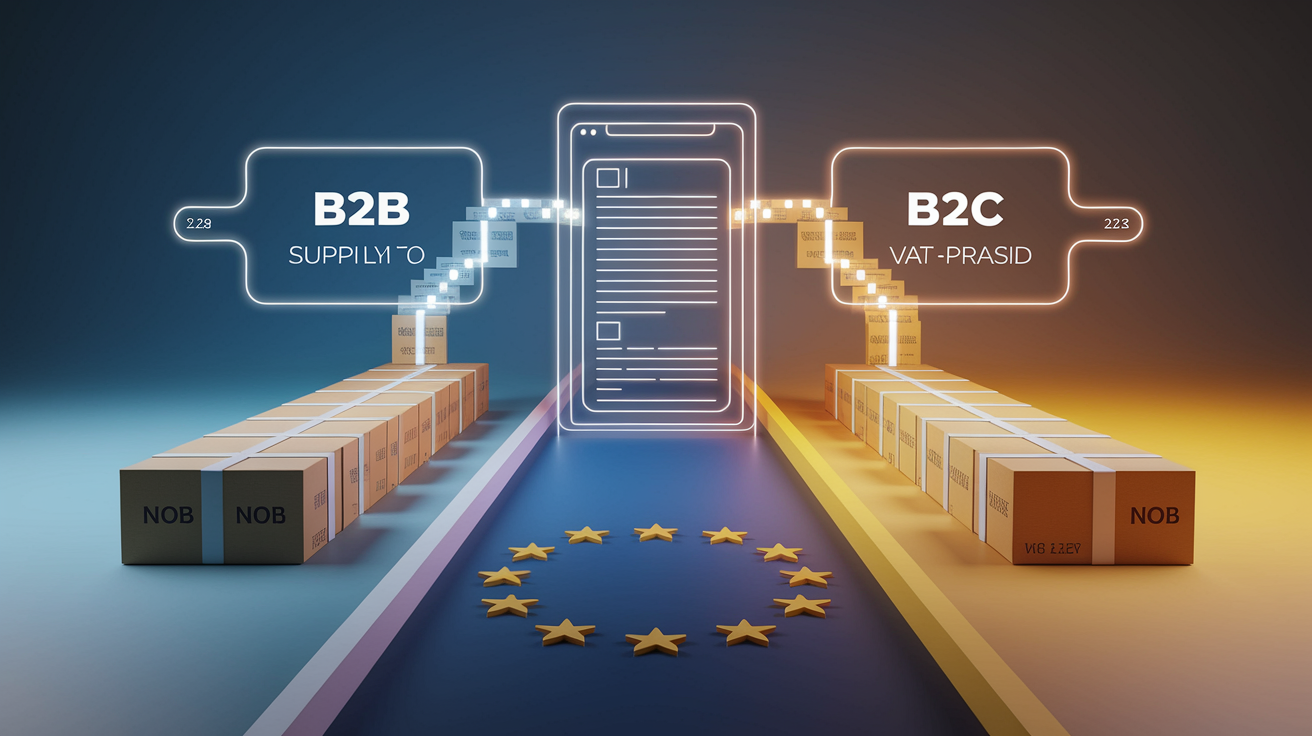
The deemed supplier model treats the marketplace as the taxable supplier for VAT purposes on qualifying cross-border sales, even though the underlying seller owns and ships the goods. This legal fiction shifts VAT collection and remittance responsibility from individual sellers to the platform, simplifying enforcement for tax authorities and reducing the burden on small sellers who would otherwise need to register in multiple member states.
The model applies to two main transaction types. When a non-EU seller stores inventory in an EU member state and sells to a consumer in another EU member state, the marketplace becomes the deemed supplier for the cross-border leg of the sale. When goods are imported into the EU with an intrinsic value at or below €150, the marketplace is deemed the supplier if it facilitates the sale.
Intrinsic value means the price of the goods themselves, excluding delivery fees and insurance, calculated at the moment of sale and timestamped to protect against exchange-rate fluctuations that could push the value above €150.
Under the deemed supplier model, the first leg of the transaction (from the underlying seller to the marketplace) is treated as a B2B supply, typically without VAT. The marketplace then makes a B2C supply to the end customer, charging VAT at the customer’s destination rate. Marketplaces must issue compliant B2C invoices to customers and may use self-billing arrangements with sellers for the B2B leg. For import sales under IOSS, no mandatory B2C invoice is required, but the marketplace should provide a commercial receipt proving VAT was collected.
Here’s how deemed supplier rules operate across the compliance lifecycle:
Seller onboarding: Marketplace collects seller headquarters location, VAT registration number (if applicable), business name, and contact details. Validates VAT numbers via VIES for claimed B2B sales.
Checkout data capture: System records product description, intrinsic value (excluding delivery and insurance), ship-from location, ship-to destination, date and time of sale, and applicable VAT rate at customer’s location.
VAT calculation and collection: For cross-border sales, marketplace applies destination VAT rate via OSS. For imports ≤ €150, marketplace applies destination VAT via IOSS. For imports > €150, VAT is charged at border and deemed supplier rules don’t apply.
Invoicing and filing: Marketplace issues B2C invoices (or commercial receipts for IOSS), files quarterly OSS returns for cross-border sales, files monthly IOSS returns for low-value imports, and remits VAT to the OSS/IOSS member state of identification.
Recordkeeping and audit readiness: Marketplace retains transaction records, invoices, seller agreements, evidence of intrinsic value calculation, and proof of VAT remittance for ten years. Reconciles internal records with DAC7 platform reports submitted annually by January 31.
For 2025, the compliance impact is that marketplaces must build or integrate systems to identify qualifying transactions, calculate VAT accurately at checkout, enforce seller data completeness, and maintain audit-ready records for a decade. Failure to classify transactions correctly or collect required seller data can result in back taxes, penalties, and joint liability with sellers or intermediaries.
Explaining OSS and IOSS Systems Used in Cross-Border VAT Compliance

The One-Stop Shop (OSS) and Import One-Stop Shop (IOSS) are EU-wide VAT reporting schemes designed to simplify cross-border VAT compliance for marketplaces and sellers. OSS applies to intra-EU cross-border sales of goods and certain services, allowing businesses to register in a single member state and file one quarterly return covering VAT owed to all 27 member states. IOSS applies specifically to low-value imports (goods shipped from outside the EU with an intrinsic value at or below €150) and allows marketplaces to collect VAT at the point of sale and remit it monthly via a single IOSS return.
For OSS, the €10,000 annual threshold applies only to EU-established businesses selling cross-border within the EU. If an EU business’s total intra-EU distance sales remain below €10,000 per year, it can apply domestic VAT rules (charge VAT at its own country’s rate). Once sales exceed €10,000, the business must register for OSS and charge VAT at the destination country rate. Non-EU businesses have no €10,000 threshold. They must register for OSS immediately on their first qualifying cross-border sale into the EU.
IOSS has no threshold. Any marketplace or seller facilitating imports of goods valued ≤ €150 can register for IOSS to collect VAT at checkout, avoiding import VAT charges and delays at customs. When IOSS is used, the customer pays VAT as part of the purchase price, the goods clear customs without additional VAT, and the marketplace remits the collected VAT monthly. If IOSS isn’t used, VAT is charged at the border, and under Article 201 member states may assign the payment obligation to the customer, the deemed supplier (marketplace), or the underlying seller. This creates potential ambiguity and friction.
| Scheme | Applicable Transactions | Filing Frequency | Threshold | Example Scenario |
|---|---|---|---|---|
| OSS (One-Stop Shop) | Cross-border intra-EU sales by non-EU sellers storing goods in EU; cross-border B2C sales by EU sellers | Quarterly | €10,000 (EU sellers only); no threshold for non-EU sellers | Non-EU seller stores inventory in Germany, sells to customer in France; marketplace collects French VAT and files via OSS quarterly return |
| IOSS (Import One-Stop Shop) | Imports from outside EU with intrinsic value ≤ €150 | Monthly | None (voluntary registration; applies to all low-value imports) | Marketplace sells €120 item from China to Spain; collects Spanish VAT at checkout (€24 at 20% rate); customer pays €144 total; goods clear customs without additional VAT |
Key functional differences between OSS and IOSS:
Geographic scope: OSS covers intra-EU movement. IOSS covers imports from outside the EU into any member state.
Value trigger: OSS has no per-transaction value limit (only the optional €10,000 annual threshold for EU sellers). IOSS applies only when intrinsic value is €150 or less.
Filing rhythm: OSS requires quarterly returns. IOSS requires monthly filings.
Intermediary requirement: IOSS requires non-EU marketplaces to appoint an EU-established intermediary who assumes joint and several liability. OSS allows direct registration by non-EU businesses without an intermediary (though some member states may require fiscal representatives for broader VAT obligations).
Customs treatment: IOSS enables VAT-paid clearance at the border. OSS doesn’t affect customs. It’s purely a VAT reporting mechanism for goods already in the EU.
Marketplaces shipping goods from outside the EU should register for IOSS to streamline imports and improve customer experience. Marketplaces facilitating cross-border sales within the EU (especially by non-EU sellers using EU warehouses) must register for OSS. Sellers using their own fulfillment may need to register for both schemes or rely on local VAT registrations depending on their storage and shipping arrangements.
Marketplace Facilitator Rules and Platform Liability Under 2025 VAT Frameworks

Marketplace facilitator rules designate the platform (not the individual seller) as the party responsible for collecting and remitting VAT on certain transactions. This liability shift began in the EU with the July 1, 2021 deemed supplier reform and has since spread to other jurisdictions. In 2025, marketplaces face heightened enforcement through DAC7 reporting, which requires platforms to submit annual seller reports to tax authorities by January 31 for any seller earning over €2,000 or completing more than 30 transactions per year.
DAC7 reporting intensifies audit risk because tax authorities now cross-check platform-submitted seller data against sellers’ own VAT filings. Mismatches (such as unreported income, incorrect VAT amounts, or invalid VAT numbers used to claim B2B treatment) trigger automated audits and penalties. The UK has also updated marketplace seller verification requirements, mandating that platforms validate seller identity, business registration, and VAT numbers before allowing sellers to list goods.
Under deemed supplier rules, the marketplace is liable for VAT on qualifying sales even if the seller provided incorrect information or failed to register for VAT. This creates a strong incentive for marketplaces to enforce seller onboarding standards, verify VAT numbers via VIES, and remove non-compliant sellers from the platform. Marketplaces that fail to collect accurate seller data or remit VAT face back taxes, interest, and penalties, often with no statute of limitations if no return was filed.
Key marketplace facilitator responsibilities in 2025:
Seller verification: Validate seller business name, headquarters location, tax ID, and VAT registration status. Check VAT numbers in VIES for B2B sales. Enforce data completeness or suspend seller accounts.
Transaction classification: Determine whether each sale is B2B (reverse charge, no VAT collected) or B2C (collect VAT at destination rate). Identify cross-border vs domestic sales. Flag imports vs intra-EU movements.
VAT collection at checkout: Apply correct destination VAT rate for OSS/IOSS transactions. Timestamp intrinsic value to prevent exchange-rate drift above €150 threshold. Separate delivery and insurance charges from intrinsic value.
Filing and remittance: Submit quarterly OSS returns and monthly IOSS returns. Remit collected VAT to member state of identification. Reconcile filings with internal transaction records.
DAC7 annual reporting: Compile seller data (name, address, VAT number, bank account, total sales, transaction count) and submit by January 31 to each member state where sellers were active.
Record retention: Retain invoices, transaction logs, seller agreements, and proof of VAT remittance for ten years.
Failure consequences include retrospective VAT assessments. Italy pursued approximately €1,000,000,000 in VAT claims against major tech platforms for past non-compliance. Plus interest, fines, and potential criminal liability in severe cases. Marketplaces also face contractual risk if seller agreements don’t clearly allocate VAT liability and indemnify the platform for seller-supplied incorrect data.
In 2025, the risk level is elevated because DAC7 reporting is now fully in force and tax authorities are using automated matching to identify non-compliant sellers and platforms. Marketplaces that haven’t implemented robust seller verification, VAT calculation engines, and recordkeeping systems should prioritize these investments to avoid multi-million-euro penalties and reputational damage.
How to Comply With Cross-Border VAT Changes for Online Marketplaces in 2025

How to Check Marketplace VAT Registration Needs
Map customer locations and transaction volumes by jurisdiction. Review the past 12 months of sales data to identify countries where you have customers. Calculate total sales per country and number of transactions to determine if you exceed local thresholds (e.g., EU €10,000 for domestic treatment, UK £90,000 for VAT registration, or US state thresholds like $100,000 in sales or 200 transactions).
Identify qualifying deemed supplier transactions. Flag sales where a non-EU seller stores inventory in an EU member state and ships cross-border to another member state. Identify imports from outside the EU with intrinsic value ≤ €150. These transactions require OSS or IOSS registration.
Confirm OSS and IOSS registration status. Check whether your marketplace is already registered for OSS and IOSS. Verify the member state of identification. If not registered and you have qualifying sales, register immediately to avoid retrospective liability.
Assess UK VAT obligations. If your UK-established sellers exceed £90,000 in taxable turnover, they must register for UK VAT. If you facilitate sales by non-UK sellers into the UK, confirm whether you’re required to collect VAT under UK marketplace rules.
Test digital service registration triggers. For non-EU sellers of digital services (software, streaming, e-books), registration for Non-Union OSS is required from the first sale with no threshold. Verify registration and file quarterly OSS returns.
How to Prepare Seller Data and Validate VAT Numbers
Accurate seller data is the foundation of deemed supplier compliance. Marketplaces must collect and verify the following fields before allowing sellers to list products:
Business headquarters and established place: Record the legal business address and country of establishment. This determines whether the seller is EU or non-EU for OSS/IOSS purposes.
VAT registration number (if applicable): Collect seller VAT numbers. Validate them in real time via VIES (VAT Information Exchange System) for B2B transactions to confirm eligibility for reverse charge (no VAT collected by marketplace).
Product descriptions and classifications: Require sellers to provide accurate product names, HS codes, and intrinsic values (price excluding delivery and insurance) to enable correct VAT and customs treatment.
Ship-from location at checkout: Capture the warehouse or dispatch location at the moment of sale. This determines whether a sale is cross-border and whether deemed supplier rules apply.
Ship-to destination (customer address): Record the customer’s delivery address and country at checkout to apply the correct destination VAT rate.
Intrinsic value with timestamp: Log the item price excluding delivery and insurance at the exact time of sale, including the exchange rate used, to protect against currency fluctuations that could push an import above the €150 IOSS threshold.
Marketplaces should enforce data completeness by blocking seller listings or suspending accounts when required fields are missing or invalid. Periodically re-validate VAT numbers to catch deregistrations or changes.
How to Calculate VAT at Checkout in 2025
VAT calculation depends on the transaction type. For cross-border intra-EU sales via OSS, apply the destination country’s standard VAT rate. For imports under €150 via IOSS, apply the destination VAT rate at checkout and remit it monthly.
Example (IOSS import sale): A marketplace sells a €120 item from China to a customer in Spain. Spain’s standard VAT rate is 21% (using 20% for illustration simplicity). The intrinsic value is €120. VAT = €120 × 20% = €24. Total charged at checkout = €120 + €24 = €144. The marketplace collects €144 from the customer, remits €24 via the monthly IOSS return, and the goods clear Spanish customs without additional VAT.
Rules for VAT at checkout vs VAT on arrival:
If the marketplace is registered for IOSS and the intrinsic value is ≤ €150, collect VAT at checkout and remit via IOSS monthly.
If the marketplace isn’t registered for IOSS or the intrinsic value exceeds €150, VAT is charged at the border when goods arrive. Under Article 201, member states may assign payment responsibility to the customer, deemed supplier, or underlying seller. This creates ambiguity and potential double-billing risk.
Timestamp the intrinsic value and exchange rate at checkout to prevent post-sale currency movements from reclassifying an import above €150.
How to Maintain Transaction Records for 10 Years
The EU requires marketplaces (as deemed suppliers) to retain transaction-level records for ten years. This obligation covers:
Timestamped transaction logs: Date, time, customer location, ship-from location, intrinsic value, VAT rate applied, VAT amount collected.
Invoice copies: B2C invoices issued to customers. Commercial receipts for IOSS sales. Self-billing invoices for B2B legs with underlying sellers.
OSS and IOSS filing records: Copies of quarterly OSS returns and monthly IOSS returns, proof of VAT remittance, reconciliation documents showing transaction totals match filed amounts.
DAC7 platform reports: Annual seller reports submitted by January 31, including seller names, addresses, VAT numbers, total sales, and transaction counts.
Seller verification records: Copies of VIES validation results, seller onboarding forms, VAT certificates, and any correspondence regarding data corrections or account suspensions.
Store these records in a secure, auditable format with version control and access logs to demonstrate compliance during tax authority audits.
How to File VAT Returns via OSS/IOSS
OSS (quarterly): Compile total sales by destination country for the calendar quarter. Calculate VAT owed per country using each country’s standard rate. Submit the OSS return via the member state of identification’s online portal by the end of the month following the quarter (e.g., Q1 return due by April 30). Remit total VAT owed in a single payment.
IOSS (monthly): Compile total import sales ≤ €150 by destination country for the calendar month. Calculate VAT owed per country. Submit the IOSS return via the IOSS portal by the end of the month following the reporting month (e.g., January sales reported by end of February). Remit total VAT in a single payment.
Reconcile internal records: Before filing, reconcile transaction data in your e-commerce platform or tax engine with the totals you’ll report. Flag and investigate discrepancies (e.g., missing VAT number validations, incorrect ship-from locations, exchange-rate errors).
Retain proof of filing and payment: Download and store PDF copies of submitted returns, payment confirmations, and any correspondence with tax authorities for the ten-year retention period.
Note that OSS deadlines are quarterly (every three months) while IOSS deadlines are monthly, creating different operational cadences that marketplaces must manage with automation or dedicated compliance staff.
Comparison of Key Cross-Border VAT Systems for 2025 Marketplaces
Understanding when to use OSS, IOSS, UK VAT rules, or DAC7 reporting requires comparing their triggers, filing rhythms, and liability assignments.
| System | Threshold | Filing Frequency | Geographic Scope | Who Is Liable | Notes |
|---|---|---|---|---|---|
| OSS (One-Stop Shop) | €10,000/year (EU sellers only); none for non-EU sellers | Quarterly | 27 EU member states (intra-EU cross-border sales) | Marketplace (deemed supplier) on qualifying cross-border sales; seller on domestic or non-marketplace sales | Single registration and quarterly return covers all member states; VAT charged at destination rate |
| IOSS (Import One-Stop Shop) | None (applies to imports ≤ €150 intrinsic value) | Monthly | All EU member states (imports from outside EU) | Marketplace (deemed supplier) if facilitating sale; requires EU intermediary for non-EU platforms | VAT collected at checkout; goods clear customs without additional VAT; non-IOSS imports face VAT at border with Article 201 ambiguity |
| UK VAT Rules | £90,000 taxable turnover for UK-established sellers; no threshold for non-UK sellers on certain marketplace sales | Quarterly or monthly (depending on turnover) | United Kingdom | UK seller or marketplace (for non-UK sellers in certain cases) | Marketplace seller verification required; £135 threshold for goods (under review); digital services taxed from first sale |
| DAC7 Reporting | >€2,000 earnings OR >30 transactions per seller per year | Annually (deadline January 31) | All EU member states where sellers are active | Marketplace must report seller data to tax authorities; seller liable for VAT but marketplace liable if deemed supplier rules apply | Automatic cross-checks with VAT filings increase audit risk; mismatches trigger investigations |
Key differences and operational impact:
Threshold logic: OSS has an annual volume threshold only for EU-established sellers. IOSS has no threshold but a per-transaction value cap of €150. UK VAT has a £90,000 annual turnover threshold for UK sellers. DAC7 reporting triggers at €2,000 or 30 transactions per seller.
Filing frequency: OSS is quarterly. IOSS is monthly. UK VAT varies by seller size. DAC7 is annual.
Liability assignment: OSS and IOSS place liability on the marketplace (deemed supplier) for qualifying sales. UK VAT can assign liability to the marketplace for non-UK sellers. DAC7 is a reporting obligation but exposes sellers to audit risk if their filings don’t match platform reports.
Geographic reach: OSS and IOSS cover all 27 EU member states. UK VAT is UK-specific. DAC7 applies wherever the seller is active in the EU.
Ambiguity zones: Article 201 creates uncertainty for non-IOSS imports over €150 or where IOSS isn’t used. Member states can assign import VAT to the customer, deemed supplier, or seller, leading to potential double-billing or unclear liability.
Marketplaces should use OSS for cross-border intra-EU sales, IOSS for low-value imports to improve customer experience and reduce delivery delays, comply with UK VAT registration and seller verification when operating in the UK, and ensure DAC7 reporting is accurate and reconciled with internal VAT records to avoid triggering audits for themselves and their sellers.
How Online Sellers and Marketplaces Can Benefit From 2025 Cross-Border VAT Rules

Despite the compliance burden, 2025 cross-border VAT rules offer competitive advantages for marketplaces and sellers who implement them correctly. Collecting VAT at checkout via IOSS eliminates surprise charges and customs delays, reducing cart abandonment and customer complaints. OSS simplifies multi-country expansion by replacing 27 separate VAT registrations with a single quarterly filing, lowering administrative costs and enabling faster entry into new EU markets.
Marketplaces that enforce robust seller verification and data collection build audit-ready systems that protect against retrospective VAT claims and penalty exposure. Automated VAT calculation and filing reduce manual error, improve accuracy, and free up compliance teams to focus on strategic growth rather than reactive firefighting. Transparent invoicing and VAT-inclusive pricing improve customer trust and repeat purchase rates, especially for cross-border buyers who’ve historically faced unpredictable import fees.
Specific benefits marketplaces and sellers can capture in 2025:
Lower cart abandonment: IOSS checkout VAT collection removes the friction of unexpected charges at delivery, improving conversion rates on cross-border sales.
Easier EU-wide expansion: OSS quarterly filing covers all 27 member states, eliminating the need for sellers to register individually in each country and reducing legal and accounting fees.
Better audit protection: Accurate transaction records, validated VAT numbers, and reconciled DAC7 reports reduce the risk of mismatches and automated audits.
Improved delivery speed: IOSS enables VAT-paid customs clearance, reducing delays and improving customer satisfaction.
Competitive differentiation: Marketplaces that offer seamless VAT-inclusive pricing and faster delivery attract sellers and customers away from competitors with manual or incomplete VAT processes.
Operational clarity: Deemed supplier rules create clear liability assignments, reducing disputes between sellers and platforms over who’s responsible for VAT collection and remittance.
Access to compliance tools: Integration with tax engines like Avalara, TaxJar, Quaderno, or Taxually automates rate lookup, evidence capture, invoice generation, and filing, reducing headcount needs and error rates.
Automation tools reduce error and penalty risk by maintaining up-to-date VAT rate tables across jurisdictions, validating VAT numbers in real time, calculating intrinsic values and destination rates at checkout, generating compliant invoices, and producing pre-filled OSS/IOSS returns. Marketplaces that integrate these tools with e-commerce platforms (Shopify, WooCommerce) and payment processors (Stripe) can scale cross-border sales without proportionally scaling compliance staff, turning regulatory complexity into a sustainable competitive moat.
Final Words
Starting July 2025, marketplaces become the VAT collector, with EU deemed supplier rules, OSS/IOSS shifts, the €150 import rule, and 10-year record retention.
That means heavier verification, VAT-at-checkout for many imports, monthly IOSS or quarterly OSS filings, and bigger penalty risk if DAC7 or VAT duties are missed.
Do this: audit top SKUs for cross-border flow, confirm OSS/IOSS and UK thresholds, tighten seller onboarding, and keep 10-year records.
This Cross-border VAT changes for online marketplaces 2025 guide gives practical steps to stay compliant and keep checkout smooth, and small fixes now stop big headaches later.
FAQ
Q: Do I need to worry about VAT as a US online seller selling to the EU?
A: You need to worry about VAT as a US online seller selling to the EU if you store goods in the EU, make B2C sales, or import goods under €150; verify OSS/IOSS registration and marketplace rules.
Q: What are the new VAT changes?
A: The new VAT changes are 2025 updates making marketplaces potentially liable under the EU deemed‑supplier model, expanding OSS/IOSS mechanics, enforcing checkout VAT for many imports ≤€150, and requiring 10‑year record retention.
Q: What is the cross border VAT?
A: Cross border VAT is the value‑added tax charged when goods or services cross borders, typically taxed at the buyer’s destination rate and collected via OSS/IOSS, import VAT, or marketplace deemed‑supplier rules.
Q: What is the online purchase trend in 2025?
A: The online purchase trend in 2025 is more cross‑border buying and low‑value imports ≤€150, with marketplaces increasingly collecting VAT at checkout—expect smoother delivery but higher compliance and verification needs.