
Think one catchy ad will turn browsers into buyers? Not even close.
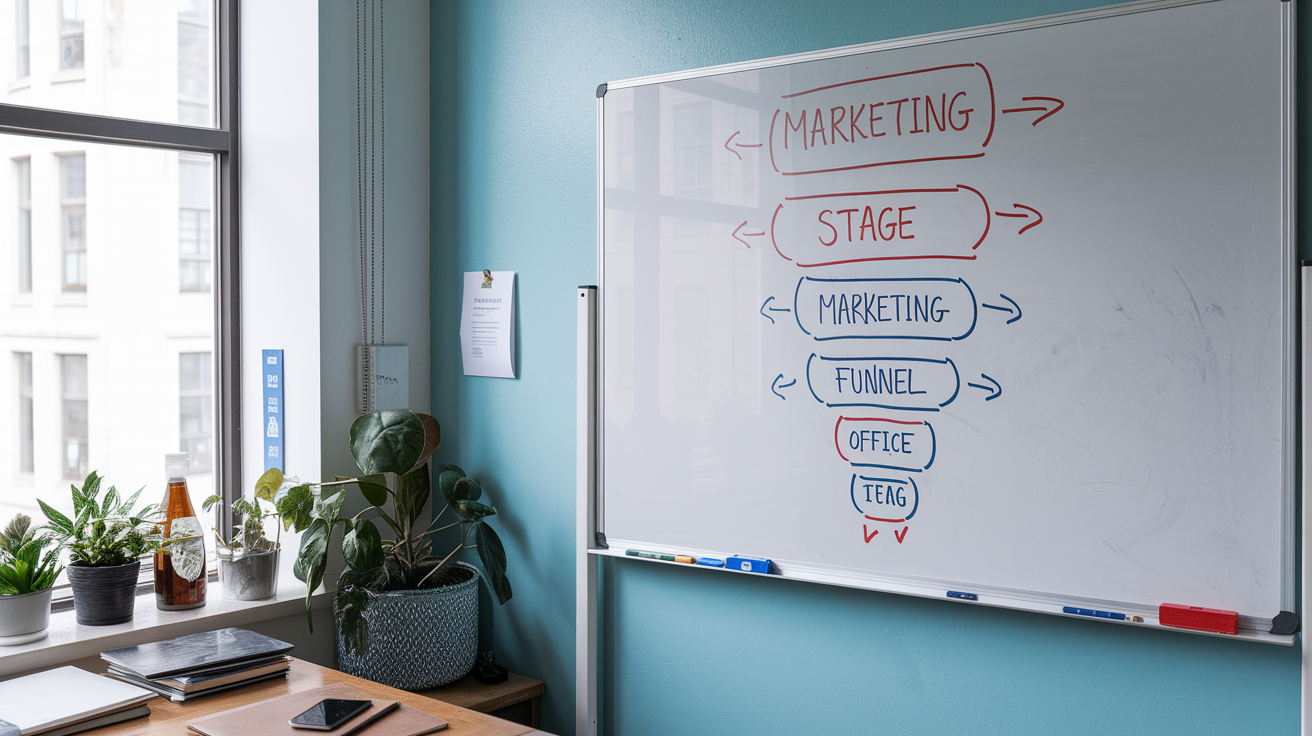
Modern funnels split the buyer journey into measurable stages, awareness, consideration, conversion, loyalty, and advocacy, and treat each stage as something you can test and fix.
That matters because the real win isn’t traffic, it’s turning a slice of that traffic into repeat customers without blowing the ad budget.
This post shows which stage to focus on, why each stage gains or leaks revenue, and the first actions to run a quick funnel audit.
Core Definition of the Marketing Funnel and Its Stages

A marketing funnel maps how someone goes from discovering your brand to buying from you (and what happens after). Think of it as tracking a big group of strangers as they narrow down to a smaller group of customers, then watching what they do next. It’s not about capturing every twist and turn in a buyer’s head. It’s about breaking a messy process into stages you can actually measure and fix.
The oldest version is AIDA (Awareness, Interest, Desire, Action), traced back to Elias St. Elmo Lewis in 1898. Most teams today use TOFU/MOFU/BOFU (Top of Funnel, Middle of Funnel, Bottom of Funnel), which splits things into awareness, consideration, and conversion. A lot of companies tack on Loyalty and Advocacy stages because repeat buyers and referrals bring in more money than chasing cold leads. Every framework does the same thing: show you where people bail and where to put your energy.
Here’s what you’re looking at:
- Awareness (Top of Funnel) – Strangers find out you exist through content, ads, search, PR, or word of mouth.
- Consideration (Middle of Funnel) – Prospects size up your offer, compare it to competitors, and dig into educational content or reviews.
- Conversion (Bottom of Funnel) – Someone buys, signs up, or books.
- Loyalty (Post-Purchase) – New customers come back, subscribe, or buy more stuff.
- Advocacy (Amplification) – Happy customers tell friends, leave reviews, and promote you without getting paid.
Funnels work because they turn the chaotic reality of buying behavior into something you can test and improve. Instead of guessing why sales tanked, you can see that 70 percent of visitors bounce after hitting your homepage, or that email open rates in the consideration stage dropped 15 percent last month. That clarity lets you move fast.
How Marketing Funnels Work Across the Customer Journey

Funnels show movement. How people go from “never heard of you” to “just ordered” and eventually “just told three friends.” At every stage, a chunk of people drop out. Some lose interest. Others pick a competitor. Many just forget. The funnel narrows because the pool shrinks, leaving only the people who keep going. AIDA makes this look like a straight line: attention leads to interest, interest to desire, desire to action. Modern funnels know it’s messier. Buyers loop back to earlier stages, compare options over and over, or pause for weeks. One team ran 310,000 simulated purchases and found buyers bounce between exploration and evaluation before converting, a zone they called the “messy middle.”
Funnels apply everywhere. A social ad impression is top of funnel awareness. A product page visit signals consideration. An abandoned cart email pushes conversion. A loyalty program email drives retention. Whether you sell online, offline, or both, the funnel maps every interaction to a stage. Selling through affiliates? Track clicks. Running a physical store? Measure foot traffic by source. Hosting a webinar? Count registrations as middle of funnel engagement. The framework bends to fit any sales model.
Understanding how stages connect helps you find leaks and fix them. If only two percent of awareness stage visitors move to consideration, you’ve got a messaging or targeting problem. If ten percent reach conversion but bounce at checkout, friction is killing deals. The funnel makes invisible patterns visible.
| Stage | User Mindset | Primary Marketing Goal |
|---|---|---|
| Awareness | “I have a problem, or I just discovered this brand.” | Generate impressions and traffic |
| Consideration | “I’m comparing options and evaluating fit.” | Build trust and demonstrate value |
| Conversion | “I’m ready to buy or sign up.” | Remove friction and close the sale |
| Loyalty / Advocacy | “I’m deciding whether to return or recommend.” | Encourage repeat purchases and referrals |
Types of Marketing Funnels and Their Use Cases

Different businesses need different funnel shapes. Some work best as straight lines, others as circles or expanding bowties. Your pick depends on your sales cycle, how customers behave, and what you need to track.
AIDA (Awareness, Interest, Desire, Action)
AIDA is the oldest funnel model, from 1898. Four steps: grab attention, spark interest, build desire, prompt action. It’s built for short, simple sales where one person decides fast. Still gets taught in marketing classes because it’s easy to explain. Example: before someone buys running shoes, you grab their attention with an ad, spark interest by talking about cushioning tech, build desire with athlete testimonials, and push action with a limited time discount.
TOFU / MOFU / BOFU (Top, Middle, Bottom of Funnel)
The three stage TOFU/MOFU/BOFU setup is what most modern marketers use. TOFU (Top of Funnel) handles awareness and audience building. MOFU (Middle of Funnel) focuses on consideration and nurturing MQLs (marketing qualified leads). BOFU (Bottom of Funnel) closes SQLs (sales qualified leads) or opportunities. This lines up cleanly with content strategy, ad targeting, and CRM stages. Use it when you need to coordinate campaigns across multiple channels and teams.
Granular 5-Stage Funnel (Awareness, Consideration, Conversion, Loyalty, Advocacy)
This version adds Loyalty and Advocacy at the end, making post-purchase behavior part of your strategy. Repeat customers cost less to get and spend more per transaction. Advocates generate free word of mouth and referrals. Research shows cutting churn by just five percent can boost profit by 25 to 125 percent. Use this if keeping customers matters as much as getting new ones.
Flywheel
The Flywheel model ditches the funnel shape for a spinning wheel. Customers enter at awareness, convert, then create momentum by referring others and buying again. The faster it spins, the more energy it stores, and the easier it gets to attract and convert new people. Flywheels put customer delight and advocacy at the center of growth. Works best for subscription products, community driven brands, and platforms that benefit from network effects.
Bowtie
The Bowtie funnel mixes a traditional funnel (pre-purchase) with an inverted funnel (post-purchase expansion). After conversion, the funnel widens again as customers buy more products, upgrade plans, or renew subscriptions. Common in B2B SaaS, where initial deals are small but expansion revenue grows over time. Use the Bowtie when your business depends on upsells, cross sells, and long term account growth.
| Framework | Core Structure | Best Use Case |
|---|---|---|
| AIDA | 4 linear stages | Simple, short cycle transactions |
| TOFU / MOFU / BOFU | 3 stages aligned to sales pipeline | Multi-channel campaigns and lead nurturing |
| Granular 5-Stage | 5 stages including loyalty and advocacy | Retention focused and subscription businesses |
| Flywheel | Circular, momentum based | Community driven and referral heavy models |
| Bowtie | Funnel + inverted expansion funnel | B2B SaaS, enterprise sales, account expansion |
Marketing Funnel Strategies and Tactics for Each Stage
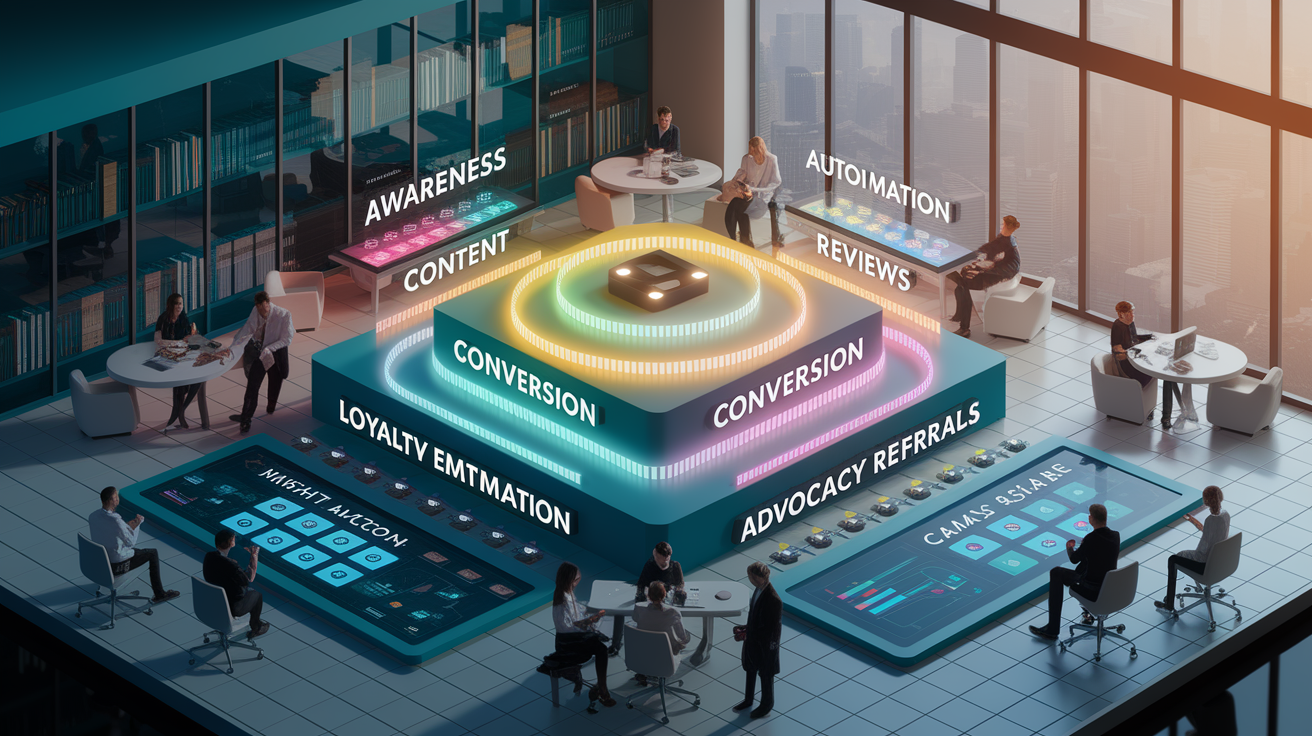
Each stage needs different content, channels, and calls to action. What works at the top (broad, educational stuff) falls flat at the bottom, where buyers need specific reasons to pick you over someone else. Matching your approach to each stage improves conversion and cuts wasted ad spend.
Awareness
Awareness tactics put your brand in front of cold audiences who’ve never heard of you. Inbound content (blog posts, how to guides, explainer videos) ranks on search engines and pulls in people looking for information. One brand published a cleaning article that now gets around 10,200 visits per month. Digital PR, guest posts, Reddit and Quora answers, events, and social all generate top of funnel impressions. Paid channels like display ads, social ads, and YouTube pre-rolls work when organic reach is too slow. The goal is volume. Get as many qualified strangers as possible to discover your brand.
Consideration
Once someone knows you exist, they figure out if your product fits their needs. Social proof (reviews, ratings, case studies, testimonials) builds trust. Brand advocates and user generated content back up your claims. Educational resources like product comparison guides, sizing charts, and FAQ pages help buyers make decisions. One mattress brand’s sizing guide pulls in more than 472,000 organic visits per month because it answers a high intent consideration question. Live support (chat, phone, email) and self serve help centers reduce friction. Monitoring brand mentions, responding to reviews, and keeping local listings current all signal you care.
Conversion
Conversion tactics remove obstacles between “I want this” and “I just bought it.” Landing pages should load fast, highlight benefits above the fold, use clear CTAs, and display social proof near the purchase button. Simplify checkout. Every extra form field costs conversions. Retargeting ads remind visitors who left without buying. Limited time offers, free shipping thresholds, and urgency cues nudge hesitant buyers across the line. If your product needs explanation, short demo videos or comparison tables can close knowledge gaps that block sales.
Loyalty
Keeping customers starts the moment they complete their first purchase. Loyalty programs with points, discounts, or early access to new products encourage repeat buying. Email follow ups with aftercare content (maintenance guides, usage tips, product suggestions) keep your brand top of mind. Social media engagement, exclusive communities, and personalized recommendations deepen the relationship. Cutting churn by just five percent can lift profit by 25 to 125 percent, making retention one of the highest ROI areas of the funnel.
Advocacy
Loyal customers who love your product are your best marketers. Referral programs with incentives for both the referrer and the new customer turn satisfaction into new sales. Encourage reviews by sending post-purchase emails asking for feedback. Turn highly engaged loyalty program members into beta testers, content creators, or brand ambassadors. Advocacy scales word of mouth and lowers customer acquisition cost over time.
Some channel specific tips for each stage:
- Awareness – Use informational keywords with monthly search volume above 100 and ranking difficulty under 50 percent to find low competition content opportunities.
- Consideration – Monitor review sites and Google Business Profile ratings. Respond to every review within 48 hours.
- Conversion – A/B test landing page headlines, CTAs, and social proof placement to find the highest converting layout.
- Loyalty – Segment post-purchase email lists by product category and send targeted upsell or cross sell offers.
- Advocacy – Ask for referrals 30 to 60 days after purchase, when satisfaction is high but the experience is still fresh.
- Multi-stage – Track funnel metrics by channel (organic search, paid social, email) to identify which sources deliver the highest lifetime value.
Real-World Examples of Marketing Funnels in Action
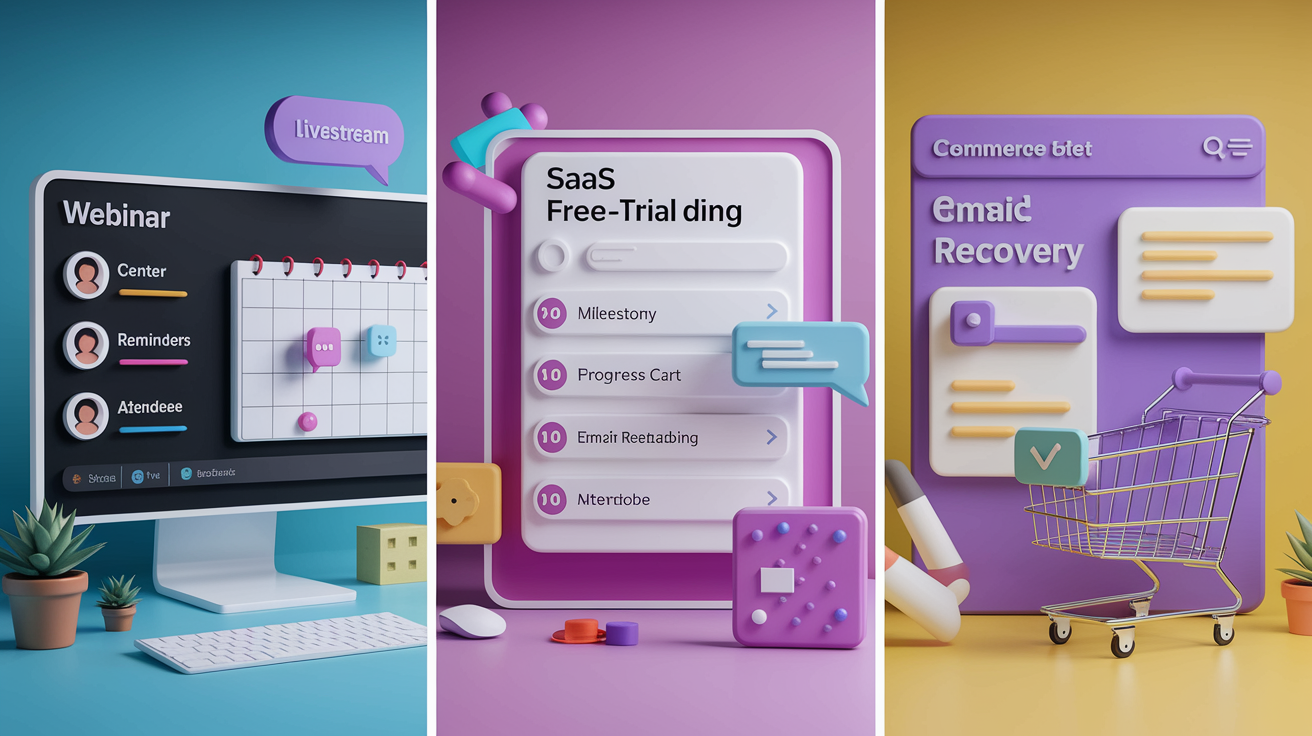
Different industries build funnels around their specific goals. A webinar funnel starts with a registration landing page (awareness), sends reminder emails (consideration), delivers the live session (conversion), and follows up with a recorded replay and offer (loyalty and advocacy). The funnel shows where people drop off. If 500 register but only 100 attend, you know to test new reminder sequences or better time slots.
A free trial funnel for SaaS moves users from signup (awareness and consideration compressed) to activation (first real use of the product) to conversion (upgrading to paid). Onboarding emails, in-app tutorials, and usage milestones nudge trial users toward activation. If only 10 percent of trial users activate a key feature, the product team knows where to focus. After conversion, the funnel extends into retention with renewal reminders, feature announcements, and expansion offers.
E-commerce checkout funnels track every step from product page to order confirmation. High abandonment at the cart page signals pricing friction, unexpected shipping costs, or form complexity. Cart abandonment emails recover 10 to 30 percent of lost sales by reminding shoppers and offering small incentives. Retargeting ads serve as a second layer of recovery, showing abandoned products on social platforms or display networks. After purchase, loyalty emails and referral prompts turn one time buyers into repeat customers.
Advocacy loops integrate into every funnel type. A customer who refers three friends becomes a top of funnel acquisition channel. A five star review on Google or a product page increases consideration stage conversion rates. Funnels reveal that advocacy isn’t separate. It’s a stage that feeds back into awareness and consideration, creating a self sustaining cycle.
| Industry | Funnel Type | Primary Goal | Key Tactics |
|---|---|---|---|
| SaaS | Free-trial funnel | Convert trial users to paid subscribers | Onboarding emails, in-app tutorials, activation milestones, upgrade prompts |
| E-commerce | Checkout funnel | Reduce cart abandonment and drive repeat purchases | Simplified checkout, cart-abandonment emails, retargeting ads, loyalty programs |
| B2B Services | Webinar or lead-magnet funnel | Generate and nurture sales-qualified leads | Gated content, email nurture sequences, sales follow-up, case studies |
Benefits and Limitations of Marketing Funnels

Funnels make invisible customer behavior visible. They show where prospects drop off, which channels bring the highest quality leads, and which tactics move people from one stage to the next. Measurable drop off rates let you prioritize fixes. If 60 percent of visitors leave after the homepage, improving that page has more impact than tweaking checkout. Funnels also help with forecasting by showing historical conversion rates at each stage, making revenue projections more accurate. Channel specific funnel data helps you put budget where it performs best.
Key benefits:
- Visibility into drop-off points – Spot where most prospects exit and fix bottlenecks.
- Stage-specific tactics – Tailor messaging, content, and offers to match user intent.
- Measurable engagement – Track impressions, clicks, conversions, and retention in one framework.
- Revenue forecasting – Use historical stage to stage conversion rates to project future performance.
- Channel optimization – Compare funnel performance across paid, organic, email, and social to reallocate spend.
- Team alignment – Sales, marketing, and product teams share a common model for discussing customer behavior.
Funnels also have limits. Real customer journeys rarely follow a straight line. Buyers loop between exploration and evaluation, influenced by things like social proof, scarcity, authority, and urgency. One research team simulated 310,000 purchase scenarios and found most decisions happen in a “messy middle” of repeated comparisons and pauses. Funnels simplify this complexity. That’s both a strength and a weakness. They help you act, but they can hide non-linear behavior.
Key limitations:
- Oversimplification – Assumes linear movement when buyers often loop, pause, or skip stages.
- Attribution challenges – Multi-touch journeys make it hard to credit a single channel or tactic.
- Static models – Many teams treat funnels as fixed instead of updating based on new data.
- Measurement gaps – Nearly 70 percent of companies don’t measure funnel effectiveness, limiting their ability to improve.
Modern funnels work best when you admit these constraints. Build in flexibility for non-linear paths. Use multi-touch attribution to credit every touchpoint. Treat your funnel as a living document that evolves with customer behavior and market conditions.
Common Misconceptions About Marketing Funnels

Some marketers think funnels are outdated, replaced by flywheels, loops, or customer journey maps. Experts disagree. Funnels are still a practical tool for structuring campaigns, measuring performance, and finding bottlenecks. The confusion comes from mixing up “funnel as a static diagram” with “funnel as a dynamic framework.” Static funnels that ignore post-purchase behavior and non-linear paths deserve criticism. Modern funnels that include loyalty, advocacy, and ongoing testing remain effective.
Another misconception is that customer movement is always linear. Awareness leads to consideration, consideration to conversion, in perfect order. Reality’s messier. Buyers skip stages, revisit earlier ones, and pause for weeks. A prospect might see an ad (awareness), visit your site months later after a Google search (consideration), abandon the cart twice (conversion friction), then convert after a retargeting email. The funnel still helps you measure and improve each touchpoint, even when the path is messy.
Common misconceptions:
- Funnels are dead – They’re not dead, but they need to evolve to include loyalty, advocacy, and non-linear behavior.
- Movement is always linear – Buyers loop, skip, and revisit stages. Modern funnels account for this.
- One funnel fits all – Different products, industries, and customer segments require tailored funnel structures.
- Funnels are set and forget – Effective funnels require continuous testing, measurement, and iteration.
- Only new customers matter – Retention and advocacy often deliver higher ROI than cold acquisition.
Metrics and Tools to Measure Funnel Performance

Tracking funnel performance requires stage specific metrics that show where prospects engage, where they drop off, and where you’re spending too much to acquire them. At the top of the funnel, measure impressions, page views, and click through rate (CTR) to gauge awareness reach. In the middle, track time on page, bounce rate, and engagement signals like video watch time or form submissions. At the bottom, focus on conversion rate (the percentage of landing page visits that result in a purchase or signup) and return on ad spend (ROAS), calculated as revenue from ads minus ad cost.
Customer acquisition cost (CAC) and lead to customer rate show whether your funnel is efficient or wasteful. If CAC is climbing faster than average order value or lifetime value, your funnel has leaks. Drop off rates at each stage reveal exactly where those leaks occur. For example, if 80 percent of visitors who start checkout never complete it, friction at that stage is costing you revenue.
Tools span analytics platforms (track traffic and conversions), behavior tracking tools (heatmaps and session recordings show where users hesitate or click), CRM systems (manage leads and pipeline stages), and A/B testing platforms (test variations of landing pages, emails, and CTAs to find the highest converting option). Use analytics dashboards to monitor trends over time and by channel, rather than relying on single snapshots.
| Metric | Stage Measured | Tool Example |
|---|---|---|
| Click-through rate (CTR) | Awareness | Google Analytics, ad platforms |
| Time on page, bounce rate | Consideration | Google Analytics, Hotjar |
| Conversion rate | Conversion | Google Analytics, CRM dashboards |
| Customer acquisition cost (CAC) | Full funnel | CRM, ad platform reporting |
| Return on ad spend (ROAS) | Conversion | Ad platforms, attribution tools |
| Drop-off rate by stage | Full funnel | Google Analytics, funnel-visualization tools |
B2B vs B2C Marketing Funnel Differences
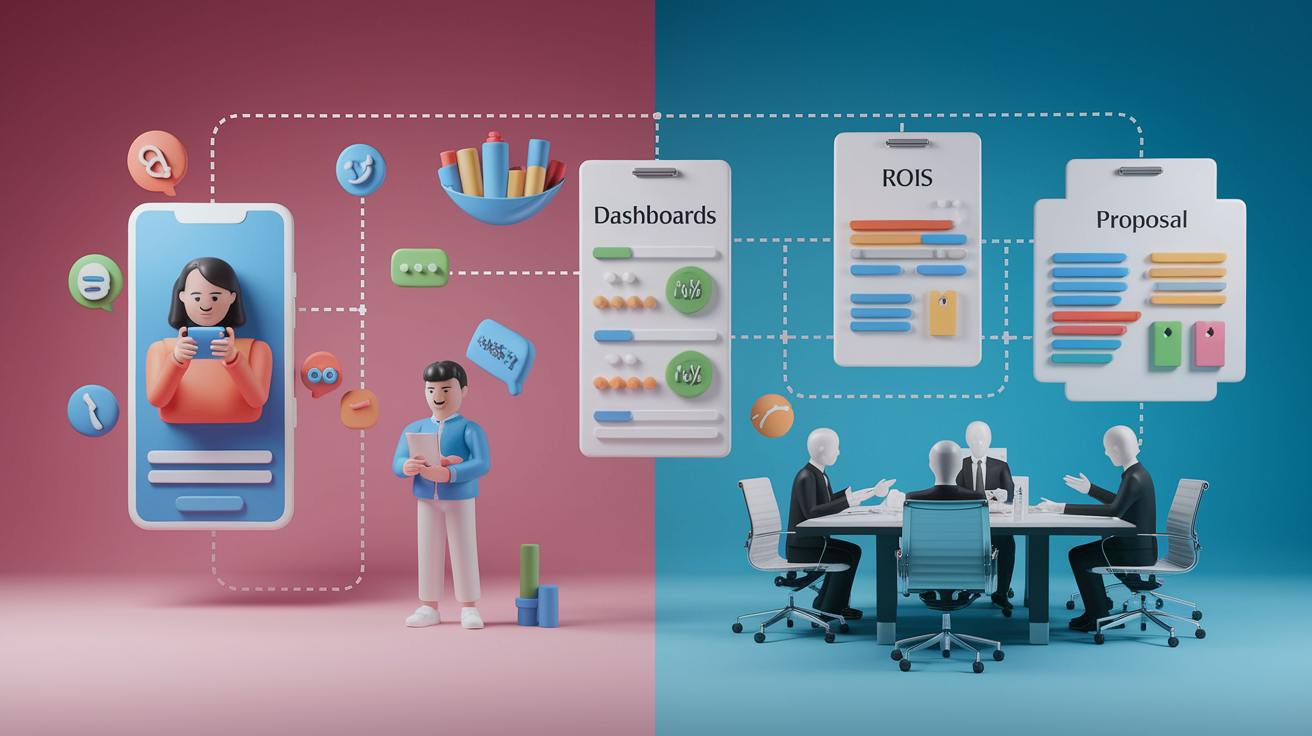
B2C funnels usually involve individuals or small groups. A shopper buying running shoes, or a couple choosing a vacation rental. Buyers often research alone or ask friends and family, and they may never talk to a company rep before purchasing. Messaging emphasizes emotion, convenience, and social proof. The sales cycle is short, often measured in hours or days. Conversion happens on a website, in a store, or through a mobile app.
B2B funnels involve multiple stakeholders: procurement, finance, IT, and end users, each with different priorities. The sales cycle stretches weeks to months. Early funnel stages (awareness and consideration) run on marketing automation and content, but lower funnel stages usually involve direct sales (demos, proposals, negotiation). Messaging emphasizes ROI, risk reduction, and long term value. Lead qualification becomes critical because not every inquiry turns into a real opportunity.
Retention and advocacy work differently, too. In B2C, loyalty programs and referral incentives drive repeat purchases. In B2B, customer success teams manage onboarding, adoption, and expansion to prevent churn and grow account value over time. Advocacy in B2B often looks like case studies, testimonials, and peer referrals within industry networks.
Key B2B vs B2C differences:
- Decision-makers – B2C: individuals or informal groups. B2B: committees with defined roles.
- Sales cycle length – B2C: hours to days. B2B: weeks to months.
- Sales interaction – B2C: often self serve. B2B: direct sales involvement in lower funnel stages.
- Messaging focus – B2C: emotion, convenience, social proof. B2B: ROI, risk, and long term value.
Applying Marketing Funnels to Real Operations and Optimization Workflows

Building and improving a funnel isn’t a one time project. It requires continuous testing, data review, and tactical adjustments. Start by mapping the current customer journey across all touchpoints: ads, website, email, support, social. Identify where most prospects drop off. Use heatmaps and session recordings to diagnose friction points on key pages. Run A/B tests on landing pages, email subject lines, and CTA copy to find what works. Get sales and marketing teams aligned around shared funnel metrics so everyone understands which leads are ready to close and which need more nurturing.
Cutting churn by just five percent can boost profit by 25 to 125 percent, making post-purchase work a high ROI area. Set up loyalty programs, send targeted upsell emails, and monitor customer satisfaction scores to catch issues before they cause cancellations. Turn satisfied customers into advocates by asking for referrals, reviews, or user generated content. Track lifetime value by cohort to see which acquisition channels deliver the best long term customers.
Practical optimization checklist:
- Map every touchpoint in your current customer journey and assign each to a funnel stage.
- Set stage specific goals (CTR for awareness, conversion rate for bottom of funnel pages).
- Identify the single biggest drop off point and fix it first.
- Run A/B tests on high traffic pages and emails to improve conversion rates step by step.
- Use heatmaps and session recordings to find where users hesitate, scroll past CTAs, or abandon forms.
- Get sales and marketing aligned around a shared lead scoring system so both teams know which prospects are ready to buy.
- Review funnel performance monthly by channel and adjust budget to the highest performing sources.
Final Words
We ran through the marketing funnel from awareness to advocacy: core definitions, AIDA vs TOFU/MOFU/BOFU, alternative frameworks (flywheel, bowtie), stage-by-stage tactics, measurement, B2B vs B2C gaps, and practical optimization steps.
The point: funnels make messy customer paths visible so you can find drop-offs, improve conversion, and lift LTV. Start with a quick audit. Map your top 3 customer journeys and spot the biggest leak.
Use the marketing funnel as a practical tool, not a theoretical model. Iterate with small tests and track the right metrics — you’ll see steady gains.
FAQ
Q: What is the marketing funnel?
A: The marketing funnel is the customer’s path from first awareness through purchase and beyond, used to identify drop-off points, tailor tactics by stage, and raise conversion and lifetime value.
Q: What are the 5 stages of the marketing funnel?
A: The five stages are Awareness, Consideration, Decision, Retention (Loyalty), and Advocacy; 4-stage models (AIDA or TOFU/MOFU/BOFU) compress or re-label stages to focus on awareness, consideration, conversion, and retention.
Q: What is the 3 funnel strategy?
A: The 3-funnel strategy refers to TOFU, MOFU, and BOFU—top, middle, and bottom-of-funnel—where TOFU builds awareness, MOFU nurtures leads, and BOFU drives conversion with targeted offers and CTAs.